

What is the EU AI Act and what does it require from German companies?
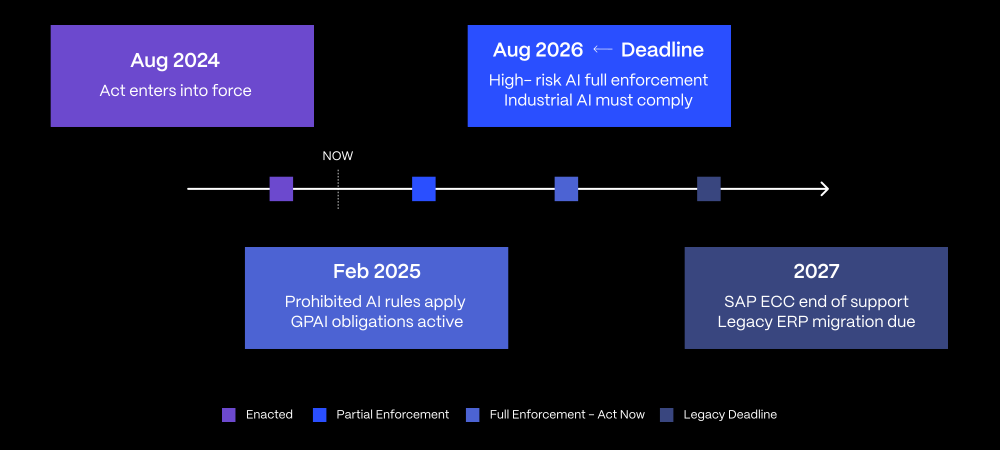
The EU AI Act (Regulation (EU) 2024/1689) is the world’s first comprehensive legal framework for artificial intelligence. It was adopted by the European Parliament in March 2024 and entered into force in August 2024. The Act classifies AI systems into four risk tiers, unacceptable, high, limited, and minimal risk, and applies its strictest compliance obligations to high-risk systems.
German industrial companies can build EU AI Act-compliant systems faster by partnering with experts in AI development and compliance-ready architectures. High-risk designation triggers obligations, including:
- Mandatory risk management systems throughout the AI lifecycle
- Technical documentation and audit-ready record-keeping
- Human oversight mechanisms capable of overriding AI decisions
- Transparency to users about how the AI system makes decisions
- Registration in the EU AI database before deployment
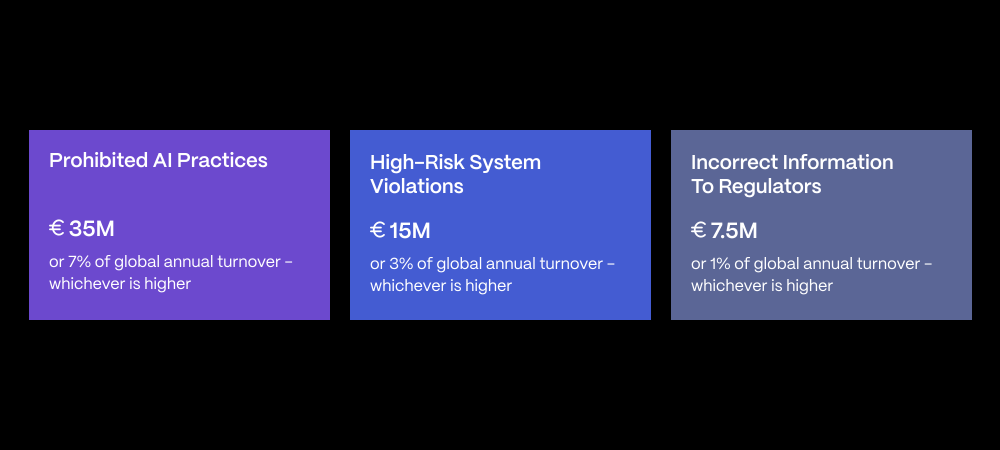
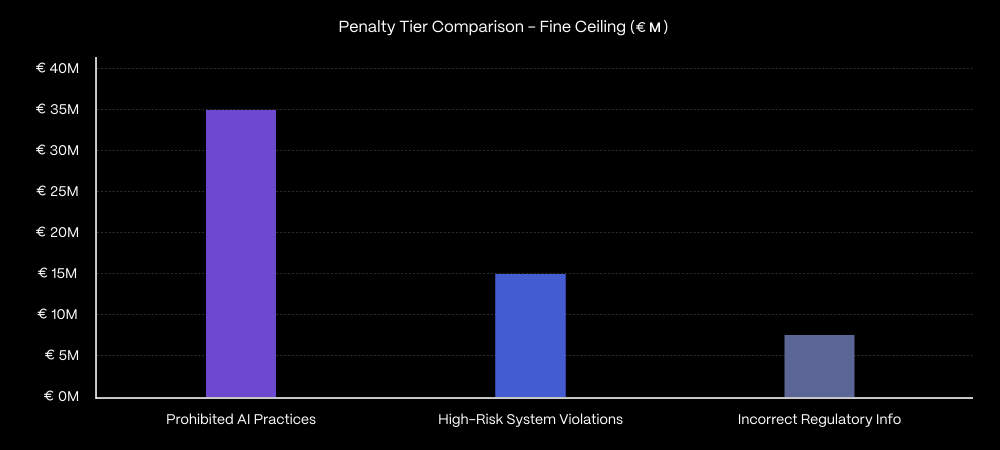
Penalties for prohibited AI practices can reach up to:
Why does agentic AI create specific compliance challenges under the EU AI Act?
Agentic AI refers to systems capable of autonomous decision-making, often built using advanced architectures like those used in modern generative AI and LLM-powered systems. In industrial contexts, agentic AI can reroute production schedules, deprioritize suppliers, adjust inventory levels, or halt production lines, all without a human approving each action.
This autonomy is precisely what makes agentic AI valuable. It is also what places agentic AI in direct tension with the EU AI Act’s three core requirements: transparency, human oversight, and accountability.
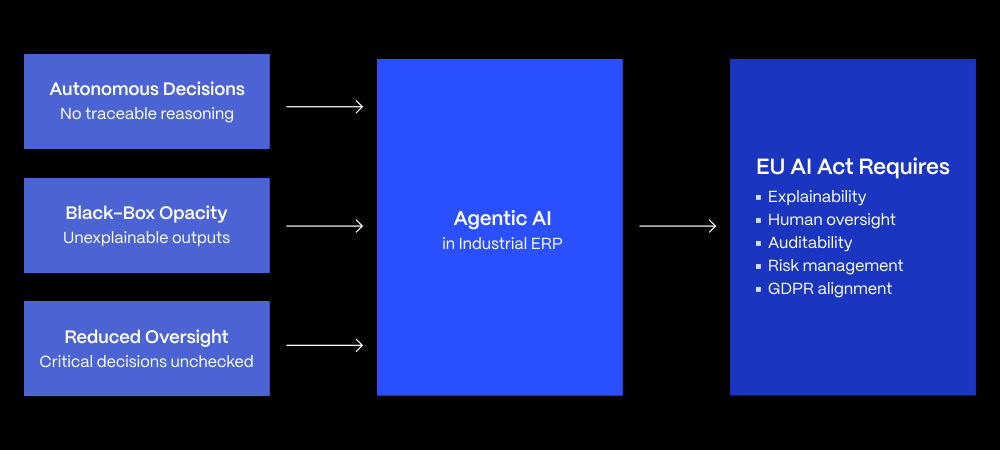
Three compliance risks are specific to agentic AI systems:
1. Autonomous decision-making without traceable reasoning: Agentic AI systems generate decisions through multi-step reasoning chains. When those chains are not recorded and explainable, the system cannot satisfy the EU AI Act’s transparency requirements. Regulators cannot audit what they cannot trace.
2. Black-box model opacity: Many foundation models that power agentic AI operate as “black boxes”, they produce outputs without exposing their internal decision logic. The EU AI Act requires high-risk AI systems to provide meaningful explanations of outputs. Black-box architectures fail this requirement by design.
3. Reduced human oversight at critical decision points: Agentic AI systems are designed to reduce human intervention. The EU AI Act requires the opposite for high-risk systems.
According to a survey by the Bitkom Digital Association, 67% of German industrial companies identified EU AI Act compliance as a significant or very significant barrier to AI deployment in their operations.
What are the core principles for building compliant agentic AI in German industry?
German industrial companies can build EU AI Act-compliant agentic AI systems by applying four foundational principles from the design phase. Retrofitting compliance onto a deployed system is significantly more expensive and technically complex than embedding it from the start.
What does explainability mean for agentic AI systems under the EU AI Act?
Explainability in the context of the EU AI Act means that an enterprise-grade AI system development must be able to provide a structured, human-readable account of why it produced a specific output or decision. For agentic AI, explainability must cover the full reasoning chain — not just the final output.
Compliant explainability for agentic AI requires:
- Reasoning path logging: Each step in the agent’s decision chain is recorded with the data inputs, rules applied, and intermediate conclusions reached.
- Plain-language summaries: Decision outputs are accompanied by explanations accessible to non-technical users and regulators, not just model logs.
- Confidence scoring: The system reports its confidence level for each decision, flagging low-confidence outputs for human review.
What does auditability require for industrial AI systems?
Auditability means every action taken by an agentic AI system must be recorded in a structured, retrievable log that links each decision to its triggering inputs, the reasoning applied, and the outcome produced. The EU AI Act requires high-risk AI systems to maintain logs automatically for a minimum period defined by the relevant sectoral legislation.
Auditability in practice requires:
- A tamper-evident log of all agent actions, indexed by timestamp and system state.
- Traceability from each output back to the input data and model version that produced it.
- Accessibility of logs to authorized internal reviewers and external regulators without requiring deep technical expertise to interpret.
How does a human-in-the-loop system work in agentic AI?
Human-in-the-loop (HITL) is an AI system design pattern in which human supervisors retain the ability to monitor, intervene, and override AI decisions at defined points in the workflow. The EU AI Act mandates HITL controls for all high-risk AI systems. For agentic AI, this requires defining which decisions are autonomous and which require human authorization. You can also get an insight on how switching from SAP to Agentic AI is more advanced.
A compliant HITL architecture for industrial agentic AI includes:
| Decision Type | Autonomy Level | Human Role |
|---|---|---|
| Routine operational actions (reorder triggers, scheduling adjustments) | Fully autonomous | Monitoring only; override available |
| Exception handling (supplier deprioritization, line halts) | Autonomous with notification | Human notified; 15-minute window to override |
| High-impact decisions (major rerouting, safety-related actions) | Requires human authorization | Human approves before execution |
What does a risk management framework for agentic AI look like?
Risk management for EU AI Act compliance means proactively identifying, assessing, and mitigating the ways an AI system could cause harm or produce non-compliant outputs, before deployment and continuously throughout the system’s lifecycle.
A compliant risk management framework for agentic AI includes:
1. Risk mapping: Identify all decision types the agent can take and classify each by potential impact severity.
2. Failure mode analysis: Define the ways each decision type could go wrong and the consequences of failure.
3. Mitigation controls: Assign a specific control to each failure mode: human review threshold, automated circuit breaker, or confidence-score gate.
4. Real-time monitoring: Deploy anomaly detection to flag decisions that fall outside normal operating parameters for human review.
5. Periodic reassessment: Review the risk framework at defined intervals and after any significant change to the system or operating environment.
What are the primary use cases for compliant agentic AI in German industrial operations?
How is agentic AI used in compliant smart manufacturing?
Smart manufacturing in Germany’s Industry 4.0 framework uses agentic AI to optimize production workflows, reduce downtime, and adapt production lines to real-time demand signals. EU AI Act compliance in smart manufacturing requires that every autonomous adjustment made by the AI system is logged, explainable, and subject to human override.
Specific applications include:
- Machine vision systems that detect production defects and trigger quality holds, with each hold logged, justified, and reviewable.
- Adaptive scheduling agents that adjust production sequences based on material availability, with schedule change rationale recorded per adjustment.
- Energy optimization agents that reduce consumption by shifting production timing, with efficiency outcomes reported transparently.
Technostacks supported a German manufacturer that faced costly SAP upgrade cycles, rigid workflows, and slow system customizations. The integration of an AI-driven operational layer delivered 100% real-time operational visibility, a 90% user adoption rate, and a 6-month deployment timeline. All AI-driven decisions within the system are logged and auditable in compliance with EU AI Act high-risk system requirements.
How does compliant predictive maintenance work under EU AI Act requirements?
Predictive maintenance uses sensor data and machine learning models to forecast equipment failures before they occur. This allows maintenance teams to intervene before a failure causes unplanned downtime or safety incidents.
For EU AI Act compliance, predictive maintenance systems must:
- Log all failure predictions with the sensor data inputs and model confidence levels that generated them
- Provide maintenance teams with an explanation of why a failure is predicted, not just an alert
- Allow maintenance engineers to override predictions and record the reasoning for that override
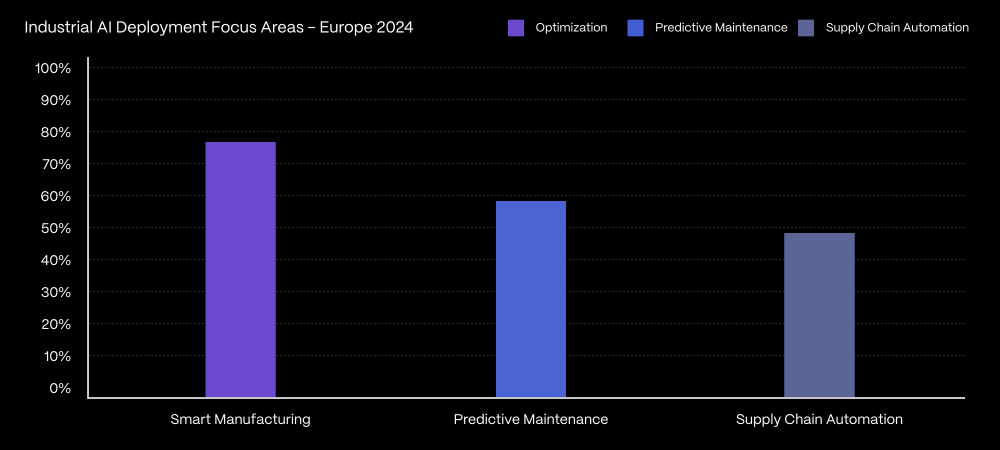
Industry 5.0 adoption data shows that 75% of industrial AI deployments focus on process optimization and 60% focus on predictive maintenance. (European Commission, Industry 5.0 Progress Report, 2024) Both application types qualify as high-risk under the EU AI Act when deployed in safety-relevant industrial environments.
How does AI-driven supply chain automation stay compliant in Germany?
Supply chain automation using agentic AI links suppliers, manufacturers, and distributors through real-time data flows. AI agents manage inventory levels, optimize delivery routing, and respond to disruptions autonomously.
For German companies whose supply chains cross EU borders, supply chain AI systems must comply with both the EU AI Act and GDPR when processing partner or supplier data.
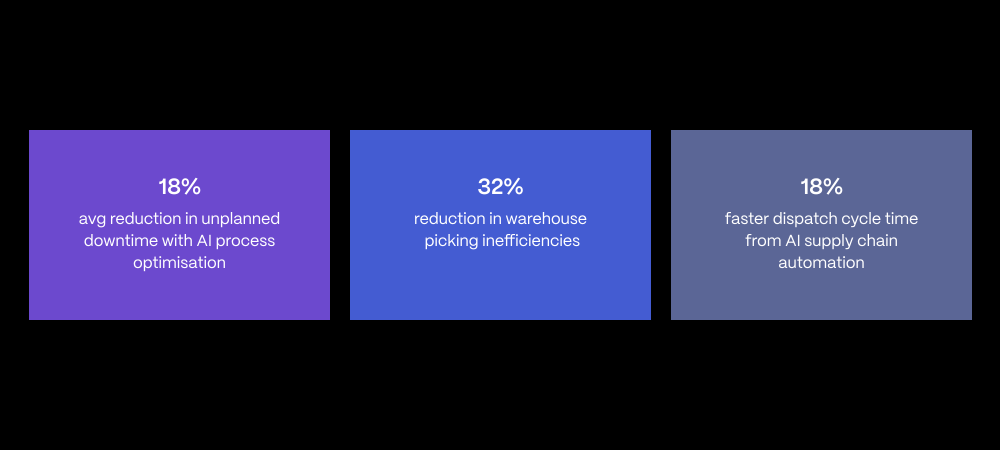
Technostacks built a real-time warehouse digital twin for a German logistics operator facing congestion, inefficient picking routes, and limited operational visibility. The solution replicated physical warehouse operations in a 3D simulation environment, enabling predictive planning without disrupting live workflows. Results included a 32% reduction in picking inefficiencies and an 18% acceleration in dispatch cycle time. All simulation-based decisions are fully auditable and traceable to their input data.
What challenges do German industrial companies face when implementing compliant agentic AI?
How do German companies address data privacy requirements for industrial AI?
Industrial AI systems process large volumes of operational data. When that data includes information about individuals, employees, suppliers, or logistics partners, GDPR applies in parallel with the EU AI Act. German companies must implement data governance policies that define what data the AI system can access, how long it is retained, and who can audit its use.
Practical steps:
- Conduct a Data Protection Impact Assessment (DPIA) before deploying any AI system that processes personal data.
- Apply data minimization, ensure the AI system accesses only the data required for its specific function.
- Establish retention schedules for AI decision logs that satisfy both EU AI Act auditability requirements and GDPR data minimization principles.
How can German manufacturers integrate agentic AI with legacy SAP and ERP systems?
Most German industrial companies have significant investments in SAP ECC or SAP S/4HANA systems. According to Gartner (2025), 61% of SAP ECC customers have not yet begun their migration to S/4HANA. Integrating agentic AI with these legacy systems requires a modular, API-based approach that avoids disrupting existing workflows.
The recommended integration pattern:
- Deploy agentic AI as an API-connected layer on top of the existing ERP system, not as a replacement.
- Map all data flows between the AI layer and the ERP system to ensure auditability of AI decisions that draw on ERP data.
- Validate that the integration does not create compliance gaps in the existing SAP audit trail.
How do German companies address the AI skills gap for compliance implementation?
A shortage of professionals with combined expertise in AI engineering and EU AI Act compliance is a significant constraint for German industrial firms. According to the Federal Employment Agency (Bundesagentur für Arbeit), demand for AI-skilled roles in German manufacturing increased by 34% between 2022 and 2024. Check this case study on Generative AI for Automated Answers, Zero Wait Time.
Practical approaches:
- Partner with AI consulting firms that specialize in EU AI Act compliance architecture for industrial environments
- Train existing engineering and compliance teams on EU AI Act obligations specific to high-risk systems
- Establish an internal AI governance committee responsible for reviewing new AI deployments against compliance requirements before go-live
What are the best practices for EU AI Act compliance in German industrial AI deployments?
Best Practice 1: Compliant-by-design architecture Build transparency, auditability, and human oversight into the AI system’s architecture from the initial design phase. Compliance added after deployment requires expensive redesigns and creates gaps that regulators can identify during audits.
Best Practice 2: Risk classification before deployment Before deploying any AI system, classify it against the EU AI Act’s Annex III risk criteria. Systems used in safety-relevant manufacturing, critical infrastructure, or employment decisions are almost certainly high-risk. Treat them as such from day one.
Best Practice 3: Continuous compliance monitoring EU AI Act obligations do not end at deployment. High-risk AI systems must be monitored continuously for performance drift, new failure modes, and changes in the regulatory environment. Establish a compliance monitoring cadence — quarterly at minimum.
Best Practice 4: Qualified AI consulting partnerships Work with AI solution providers that have demonstrable expertise in EU AI Act compliance architecture. Verify that any external AI system or model being integrated into industrial operations has been assessed against high-risk criteria.
Best Practice 5: Internal AI governance structure Designate an internal AI governance owner responsible for maintaining compliance documentation, managing the risk register, and liaising with regulators. The EU AI Act requires organizations to assign clear accountability for AI system oversight.
What is the future of AI regulation in Europe beyond the EU AI Act?
The EU AI Act is the first layer of a broader regulatory architecture that European institutions are actively building. German industrial companies should plan for the following developments:
| Regulatory Development | Timeline | Impact |
|---|---|---|
| EU AI Act full enforcement (high-risk systems) | August 2026 | All high-risk AI systems must be compliant or removed from market |
| EU AI Liability Directive | Expected 2025–2026 | Establishes civil liability for harm caused by AI systems |
| Sector-specific AI regulations (medical devices, financial services) | Ongoing | Additional compliance layers for AI in regulated sectors |
| European AI Office oversight expansion | 2025 onwards | Increased audit activity and enforcement actions |
According to PwC’s European Regulatory Outlook 2025, companies that invest in EU AI Act compliance infrastructure now are expected to reduce their total regulatory compliance costs by 20–30% compared to those that wait for enforcement to begin. (PwC, European Regulatory Outlook, 2025)
Core Compliance Principles at a Glance
| Principle | Key Requirement | Implementation Approach |
|---|---|---|
| Explainability & Transparency | Clear, traceable reasoning paths for every AI decision | Structured decision logging; plain-language output summaries; confidence scoring |
| Auditability | Tamper-evident record of all AI actions linked to inputs and outcomes | Automated audit logs; version-controlled model records; regulator-accessible reporting |
| Risk Management | Proactive identification and mitigation of failure modes | Risk mapping; failure mode analysis; real-time anomaly monitoring |
| Human-in-the-Loop | Human oversight and override capability at all critical decision points | Tiered autonomy model; mandatory human authorization for high-impact decisions |
| Data Governance | GDPR-aligned data access, retention, and minimization for AI inputs | DPIA before deployment; data minimization controls; retention schedules |
Conclusion
EU AI Act compliance is not a constraint on innovation. It is the foundation on which trustworthy industrial AI is built. German industrial companies that embed explainability, auditability, and human oversight into their agentic AI systems from the design phase will meet regulatory requirements faster, avoid costly remediation, and build the kind of operational trust that creates a durable competitive advantage in Europe’s regulated market.
The enforcement deadline for high-risk AI systems is August 2026. The time to build compliant systems is now, not after the first audit.
Frequently Asked Questions About EU AI Act Compliance for Agentic AI
1. What is the EU AI Act and when does it apply to German industrial companies?
The EU AI Act (Regulation (EU) 2024/1689) entered into force in August 2024. Full enforcement for high-risk AI systems begins in August 2026.
2. What makes an AI system “high-risk” under the EU AI Act?
If they are used in Sectors listed in Annex III, which includes critical infrastructure, manufacturing safety components, employment and worker management, and essential private and public services.
3. Does agentic AI require human oversight under the EU AI Act?
Yes. The EU AI Act requires all high-risk AI systems to include human oversight mechanisms that allow authorized personnel to monitor, intervene, and override AI decisions.
4. What are the penalties for non-compliance with the EU AI Act?
Penalties for Using prohibited AI practices reach up to €35 million or 7% of global annual turnover. Violations of obligations for high-risk AI systems carry fines of up to €15 million or 3% of global turnover.
5. Can German companies use agentic AI in manufacturing and still be EU AI Act compliant?
Yes. Agentic AI in manufacturing is compliant when it is built with explainability, auditability, and human oversight from the design phase.