

AI Consulting for Smarter Decisions
In most organizations, data is everywhere, and clarity is rare.
Dashboards glow. Reports pile up. Metrics move. Yet decisions still feel reactive, slow, or driven by instinct rather than insight. This gap between information and impact is where AI consulting has quietly become a strategic lever for modern enterprises.
The real value of AI is not in prediction models or automation alone. It lies in how effectively businesses turn raw data into confident, repeatable, high-quality decisions. This is the shift toward decision intelligence, reshaping how leadership teams approach growth, risk, and transformation.
Why Data Alone Doesn’t Drive Business Outcomes
Most companies are already data-rich. What they lack is decision readiness.
According to Gartner, by 2026, over 65% of organizations will shift from traditional analytics to decision intelligence frameworks to improve decision velocity and quality.
Traditional analytics answer questions like:
- What happened?
- Why did it happen?
AI-powered systems go further:
- What will happen next?
- What should we do about it?
This evolution is at the heart of AI-driven decision-making, where insight is no longer static but continuously shaped by models, data streams, and business context.
How AI Consulting Improves Business Outcomes
When leaders ask how AI consulting improves business outcomes, the answer lies in structure, not software.
AI consulting brings together strategy, architecture, and execution. Instead of deploying disconnected tools, organizations build systems that align data, models, and decision pathways with business goals.
Core Impact Areas
| Business Area | AI Consulting Impact |
|---|---|
| Strategy | Aligns AI initiatives with revenue, cost, and growth metrics |
| Operations | Automates decision-heavy workflows |
| Risk | Improves forecasting and anomaly detection |
| Customer Experience | Personalizes engagement at scale |
| Leadership | Enables data-backed planning |
According to McKinsey, companies that embed AI into core business processes see productivity improvements of up to 40% in specific functions.
Turning Data Into Business Insights That Drive Action
The promise of turning data into business insights often collapses at the handoff between analytics teams and decision-makers.
AI consulting bridges this gap by designing systems that deliver insights within workflows, not bury them in reports.
This typically involves:
- Integrating AI models into operational systems
- Embedding recommendations into dashboards, CRMs, and ERPs
- Automating alerts when thresholds are crossed
- Creating feedback loops that improve model accuracy
This is how data-driven decision-making becomes operational rather than theoretical.
AI Consulting for Business Growth and Transformation
AI consulting for business goes beyond technical implementation. It focuses on organizational readiness.
Many AI projects fail because teams underestimate the cultural and process changes required to act on machine-generated insight. According to Deloitte, lack of internal alignment and unclear ownership are among the top barriers to AI adoption in enterprises.
This is why AI business transformation often begins with:
- Process mapping
- Data governance design
- Change management strategy
- Leadership enablement
AI becomes effective when people trust it, understand it, and know how to act on it.
AI Strategy Consulting: From Vision to Roadmap
A strong AI strategy consulting engagement turns ambition into execution.
Instead of asking, “Where can we use AI?” teams ask:
- Where do decisions slow down revenue?
- Where does risk go unnoticed?
- Where do manual processes limit scale?
From there, consultants design a roadmap that aligns business priorities with enterprise AI solutions, including predictive analytics, AI for business intelligence, and real-time optimization systems.
Applied AI for Enterprises: Where Value Actually Emerges
Applied AI for enterprises is less about experimentation and more about integration.
Common high-impact use cases include:
- Demand forecasting in supply chains
- Fraud detection in finance
- Predictive maintenance in manufacturing
- Customer churn prediction in SaaS
- Workforce optimization in operations
According to PwC, AI-driven systems could contribute up to $15.7 trillion to the global economy by 2030, largely through improvements in productivity and decision quality.
AI-Driven Decision Making in Practice
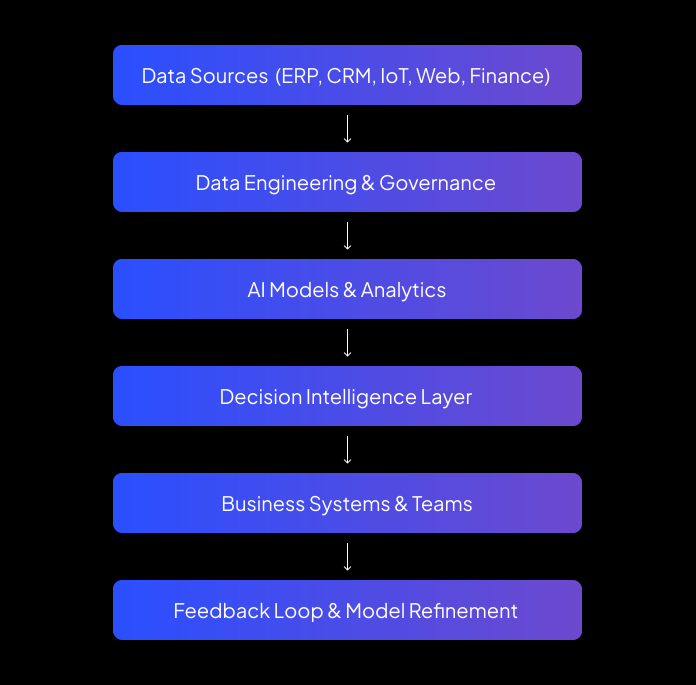
This loop transforms static reporting into a living system that continuously improves outcomes.
AI Consulting Services vs In-House AI Teams
Many organizations struggle to decide whether to build internal AI teams or work with AI consulting services.
Here is a practical comparison:
| Dimension | In-House Teams | AI Consulting Services |
|---|---|---|
| Speed | Slower ramp-up | Faster deployment |
| Expertise | Deep internal knowledge | Cross-industry perspective |
| Cost | High long-term investment | Flexible engagement |
| Innovation | Incremental | Exposure to best practices |
| Scalability | Limited by hiring | On-demand scale |
In practice, many enterprises adopt a hybrid model in which consultants design and launch systems, while internal teams maintain and evolve them.
Decision Intelligence as a Leadership Capability
At the executive level, decision intelligence becomes a strategic asset.
Instead of reviewing lagging indicators in quarterly reports, leadership teams gain access to forward-looking signals that highlight:
- Emerging risks
- Growth opportunities
- Operational bottlenecks
This shifts planning from reactive to predictive, a defining advantage in competitive markets.
Enterprise AI Solutions: Scaling Beyond Pilots
One of the biggest challenges in AI adoption is moving beyond proofs of concept.
Enterprise AI solutions focus on:
- System integration
- Security and compliance
- Performance at scale
- Monitoring and governance
According to IBM, organizations that operationalize AI across departments achieve significantly higher ROI compared to those running isolated pilots.
“The value of AI is not in the model. It’s in the moment a decision changes because of it.”
This perspective captures why AI consulting has become a board-level conversation rather than a technical initiative.
Conclusion: From Insight to Impact
The journey from data to decisions is no longer linear. It is a continuous loop of learning, prediction, action, and refinement.
AI consulting plays a central role in designing this loop, ensuring that technology, people, and processes move in sync. When done well, it transforms analytics into outcomes, automation into advantage, and data into a strategic asset that compounds over time.
In an economy shaped by speed and complexity, the organizations that win will not be those with the most data, but those that make the best decisions with it.
FAQs
1. What is AI consulting, and how does it help businesses make better decisions?
AI consulting helps organizations design and implement systems that turn data into actionable insights. It improves AI-driven decision-making by embedding predictive models and analytics directly into business workflows, allowing leaders to make faster, more confident, and data-backed decisions.
2. How do AI consulting services differ from traditional IT consulting?
AI consulting services focus on applying machine learning, automation, and analytics to business problems rather than just managing infrastructure or software deployments. The goal is to create enterprise AI solutions that continuously improve performance, forecasting, and operational efficiency.
3. How does AI consulting for business support digital transformation?
AI consulting for business supports AI transformation by aligning advanced technology with strategic goals, redesigning processes around intelligent systems, and helping teams adopt data-driven operating models rather than manual or reactive workflows.
4. What is decision intelligence, and why is it important for enterprises?
Decision intelligence combines data, AI models, and business rules to guide actions rather than just report insights. It helps enterprises move from data-driven decision-making to predictive, proactive decision-making, improving growth, risk management, and operational control.
5. How does AI strategy consulting create long-term business value?
AI strategy consulting creates long-term value by building a roadmap that connects business priorities with scalable AI initiatives. It ensures that investments in enterprise AI deliver measurable outcomes, including revenue growth, cost optimization, and improved customer experience.
6. What types of enterprise AI solutions are most commonly implemented?
Common enterprise AI solutions include demand forecasting systems, fraud detection platforms, intelligent customer support, predictive maintenance tools, and workforce optimization models. These solutions help organizations scale decision-making across departments.
7. How does turning data into business insights improve operational performance?
Turning data into business insights allows organizations to identify inefficiencies, predict risks, and optimize workflows in real time. When combined with AI-driven systems, insights are delivered directly into business tools, enabling faster and more consistent action.
8. When should companies use AI consulting services instead of building in-house AI teams?
Companies often use AI consulting services when they need faster deployment, cross-industry expertise, or strategic guidance. Consultants help design systems and governance models while internal teams focus on long-term ownership and optimization.
9. How do organizations measure the impact of AI-driven decision-making?
Organizations measure impact by tracking key metrics such as cost reduction, revenue growth, process efficiency, forecast accuracy, and decision turnaround time. These indicators help quantify how AI improves business outcomes over time.