

Human and AI Collaboration: Redesigning Business Processes
For years, automation was the end goal. Faster systems. Fewer humans in the loop. Lower costs through rules, scripts, and rigid workflows. But as AI enters core business functions, many enterprises are discovering a hard truth: pure automation breaks down where judgment, accountability, and trust matter most. This is why human AI collaboration has moved from an operational discussion to a boardroom priority.
The most resilient organizations are no longer asking how to replace people with AI. They are asking how humans, data and AI work together in business to make better decisions, faster, without losing control.
1. The Shift From Automation to Collaboration
Early enterprise AI adoption focused on efficiency. Automate tasks. Remove friction. Reduce dependency on people. But real-world environments rarely behave like clean datasets.
Nearly 70% of AI initiatives stall after the pilot stage due to workflow misalignment and a lack of human integration. Systems optimized for automation struggle when context shifts, data changes, or exceptions arise.
This has reframed AI not as a replacement, but as a collaborator. A system that augments human decision-making rather than owning it.
That distinction defines modern human AI collaboration.
2. What Human + AI Collaboration Really Means in Business
At its core, collaboration means shared responsibility between humans and intelligent systems.
Human-Centered AI and Human-in-the-Loop AI
Human-centered AI prioritizes usability, transparency, and trust.
Human-in-the-loop AI ensures that critical decisions always include human validation, override, or escalation.
This is fundamentally different from task automation.
| Automation | Human + AI Collaboration |
|---|---|
| Executes rules | Augments judgment |
| Optimizes speed | Balances speed and trust |
| Eliminates humans | Elevates human role |
| Low accountability | Clear ownership |
In areas like compliance, finance, healthcare, and risk management, human judgment consistently outperforms machines when context, ethics, or uncertainty is involved.
This is where AI human augmentation becomes essential.
3. Why Traditional Business Processes Break in the AI Era
Most legacy workflows were designed for predictability. Static rules. Linear approvals. Siloed systems.
AI introduces adaptive intelligence into environments that were never built for it.
Common failure points include:
- Data locked in departmental silos
- Delayed human approvals are breaking real-time AI insights
- Over-automation of high-risk decisions
- Lack of accountability when AI outputs go wrong
According to Gartner, 85% of enterprise AI failures stem from process design issues rather than model performance.
These are early warning signs of misaligned enterprise AI adoption.
4. Redesigning Business Processes With Humans in the Loop
AI-driven process transformation is not about inserting AI into existing workflows. It requires rethinking how decisions are made.
Principles of Human in the Loop Process Design
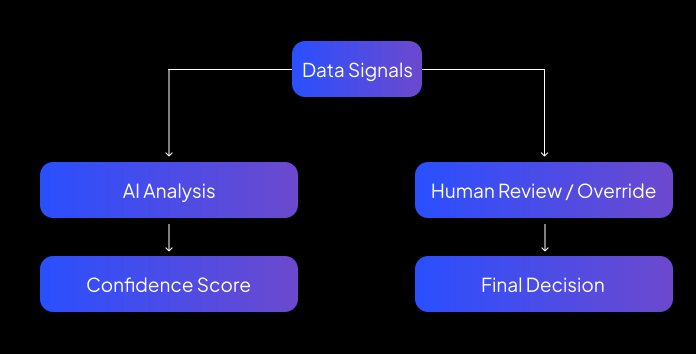
1. AI proposes, humans decide
2. Exceptions escalate to people, not systems
3. Confidence thresholds trigger review
4. Every AI decision has a human owner
Where Humans Should Stay in the Loop
- Risk scoring
- Financial approvals
- Strategic planning
- Compliance and governance
- Customer-impacting decisions
This balance ensures speed without sacrificing trust.
5. How Humans and AI Work Together in Real Enterprise Scenarios
AI for Decision-Making in Business Processes
AI excels at pattern recognition, forecasting, and signal detection. Humans excel at interpreting consequences.
Example workflow:
Practical Examples of Human AI Collaboration in Enterprises
- Forecasting systems where planners override AI projections during market volatility
- Risk engines flagging anomalies that auditors validate
- Operations dashboards recommending actions that managers approve
A strong applied example of this model can be seen in Technostacks Diamond Screener App, where AI surfaces decision intelligence, but final judgment remains human-led:
Diamond Screnner App
This approach reflects AI workforce collaboration, not automation.
6. Human + AI Collaboration by Business Function
| Function | AI Role | Human Role |
|---|---|---|
| Operations | Optimization suggestions | Final approvals |
| Finance | Anomaly detection | Risk ownership |
| Sales & Marketing | Pattern detection | Strategy definition |
| Leadership | Signal synthesis | Decision authority |
Across functions, AI becomes a signal generator, while humans remain decision owners.
7. Governance, Trust, and Accountability in Human-Centered AI
“Human in the loop” is not a feature. It is a governance requirement.
Regulators increasingly expect:
- Explainable AI outputs
- Bias mitigation
- Audit trails
- Clear accountability
According to OECD AI Principles, human oversight is a core requirement for trustworthy AI systems (OECD).
Without governance, AI erodes trust internally long before it creates external value.
8. Building an AI Transformation Strategy Around People
Many AI initiatives fail because organizations invest in technology before redesigning processes.
A successful AI transformation strategy includes:
- Process redesign before model deployment
- Workforce upskilling
- Change management
- Phased rollout
Phased Enterprise AI Transformation
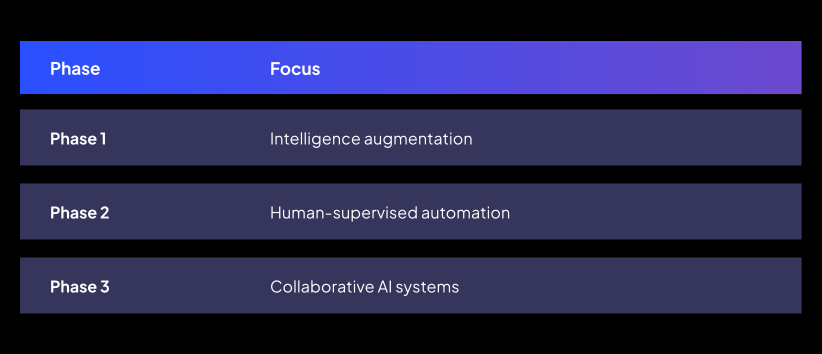
More on this approach is explored in Technostacks’ perspective on
AI for Business Intelligence
9. When Human + AI Collaboration Requires External Expertise
Not every organization needs to build from scratch.
Signals it may be time to involve a technology consulting company:
- AI pilots not scaling
- Conflicting stakeholder expectations
- Unclear governance models
- Data architecture limitations
Decision-makers often evaluate whether to build, partner, or pause before scaling.
10. Preparing for the Next Phase: AI Agents and Collaborative Systems
The next evolution is AI agents. Systems that act autonomously, but under human supervision.
According to MIT Technology Review, enterprises are increasingly favoring supervised agents over autonomous systems due to accountability concerns (MIT Technology Review).
11. Conclusion: The Future Is Not AI-First, It’s Human-Aligned
The most successful enterprise AI systems will not necessarily be the smartest; they will be the most finely calibrated. As we move beyond the “pilot phase” of generative AI, the goal has shifted from simple automation to a sophisticated redesign of human-machine boundaries.
True collaboration requires acknowledging a difficult truth: more human intervention isn’t always better. The “sweet spot” lies in knowing where AI should work autonomously for speed, and where humans must maintain a “moat” of empathy, ethics, and strategic intuition. Redesigning processes for the AI era means solving for automation bias; ensuring that humans don’t just “rubber stamp” AI outputs, but provide the critical skepticism and context that models lack.
Bridging the Gap with Technostacks, Designing this balance is not a one-size-fits-all endeavor. Technostacks helps enterprises move past the hype by building human-centered AI systems that account for real-world friction.
FAQs
1. What is human AI collaboration in business processes?
Human AI collaboration refers to a working model where artificial intelligence supports, augments, and enhances human decision-making rather than replacing it. In business processes, this means AI generates insights, recommendations, or predictions, while humans retain oversight, accountability, and final decision authority.
2. How is human-centered AI different from traditional automation?
Human-centered AI focuses on designing AI systems around human needs, judgment, and trust. Unlike traditional automation, which removes humans from workflows, human-centered AI ensures people remain involved through validation, supervision, and escalation, especially in high-impact decisions.
3. What does human-in-the-loop AI mean for enterprises?
Human-in-the-loop AI ensures that humans actively review, approve, or override AI outputs at key decision points. For enterprises, this model improves governance, reduces risk, and increases trust in AI-driven systems, making it essential for regulated and high-stakes environments.
4. How does AI-driven process transformation improve business outcomes?
AI-driven process transformation improves outcomes by redesigning workflows to combine machine intelligence with human expertise. Instead of automating entire processes, organizations embed AI into decision points, enabling faster insights, better accuracy, and more resilient operations.
5. How do humans and AI work together in business decision-making?
In modern enterprises, AI supports decision-making by analyzing large datasets, identifying patterns, and forecasting outcomes. Humans then apply context, ethics, and strategic judgment to those insights. This collaborative approach defines how humans and AI effectively work together in business.
6. How does AI workforce collaboration impact employees and teams?
AI workforce collaboration changes roles rather than eliminating them. AI takes on repetitive analysis and pattern detection, while employees focus on decision-making, strategy, and oversight. This model supports AI human augmentation and increases productivity without removing accountability.
7. Why is AI for decision-making in business processes not fully autonomous?
AI for decision-making in business processes is rarely fully autonomous because real-world decisions involve uncertainty, ethics, and accountability. Human oversight ensures that AI recommendations are interpreted correctly and aligned with business goals and regulatory requirements.
8. How should enterprises approach an AI transformation strategy?
An effective AI transformation strategy starts with process redesign, not technology deployment. Enterprises should assess where AI can augment decisions, define human-in-the-loop controls, and scale adoption gradually. This approach supports sustainable enterprise AI adoption and avoids failed pilots.
9. When should businesses seek external expertise for human AI collaboration?
Businesses should consider external expertise when AI initiatives stall, governance is unclear, or internal teams lack experience in redesigning processes for collaboration. Technology consulting partners help align AI in business processes with strategy, compliance, and long-term scalability.