

Industry 5.0 vs Industry 4.0: Why AI-Human Collaboration is the Next Frontier
What is Industry 5.0 and how does it differ from Industry 4.0?
Industry 5.0 prioritizes human-AI collaboration where machines handle data processing and pattern detection while humans focus on judgment, creativity, and strategy. Industry 4.0 automated production through connectivity and data. Industry 5.0 augments humans using that data. The shift emphasizes worker resilience, sustainability, and human-centered outcomes alongside operational efficiency.
Definition of Industry 5.0
- It is the manufacturing paradigm where artificial intelligence systems collaborate with human workers to achieve outcomes neither could reach alone. It combines the automation of Industry 4.0 with human skills, creativity, and ethical decision-making.
Definition of Industry 4.0
- The fourth industrial revolution, introduced interconnected machines, data analytics, and automation. It focused on digitization and machine autonomy without prioritizing human roles.
Industry 5.0 is centered on a human-centric, sustainable, and resilient approach to manufacturing, 2021. According to McKinsey, 72% of manufacturers expect AI to augment workers rather than replace them by 2025, 2024.
Technostacks is an Operational Transformation Partner. We help manufacturing, industrial, logistics operations, and enterprise businesses design smart factories where AI and humans work together.
What are the core differences between Industry 4.0 and Industry 5.0?
Industry 4.0 and Industry 5.0 differ in focus, objectives, and the role of human workers. The following table shows the key distinctions:
| Aspect | Industry 4.0 | Industry 5.0 |
|---|---|---|
| Focus | Machine automation and connectivity | Human-AI collaboration |
| Primary goal | Production efficiency and cost reduction | Worker augmentation and resilience |
| Human role | Operator of automated systems | Strategic decision-maker with AI support |
| Sustainability | Secondary concern | Primary strategic priority |
| Technology focus | IoT, cloud, big data analytics | AI, machine learning, digital twins |
| Value creation | Speed and scale | Speed, quality, purpose, and human dignity |
| Decision-making | Automated rules and algorithms | Hybrid AI recommendation + human judgment |
Industry 4.0 treated workers as operators monitoring machines. Industry 5.0 treats workers as collaborators, making high-value decisions supported by AI insights. AI helps reduce unplanned downtime, here’s how.
What does human-AI collaboration mean in manufacturing?
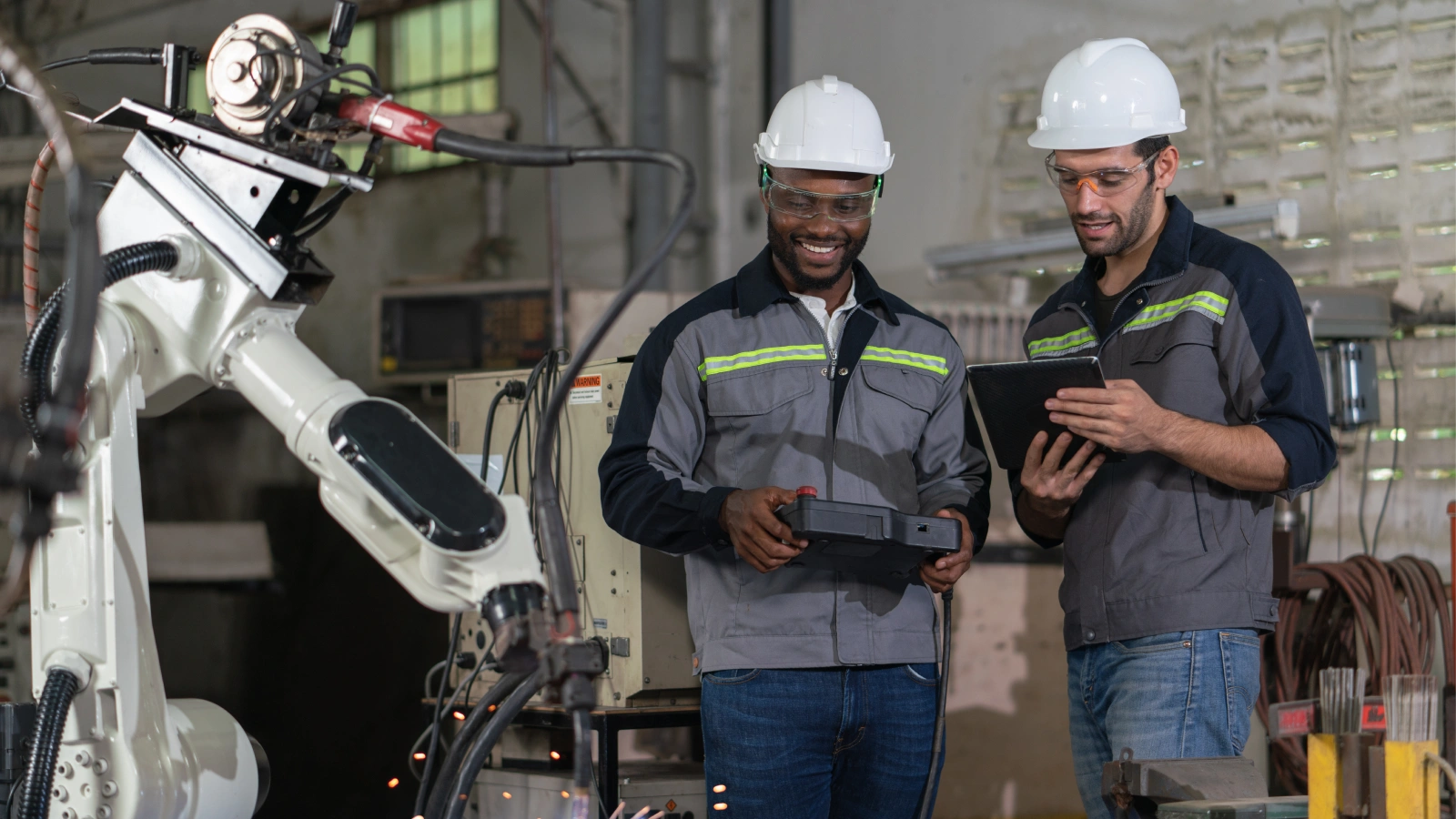
Human-AI collaboration in manufacturing means AI systems process data and recommend actions while humans validate, refine, and approve decisions. Humans provide ethical oversight, contextual understanding, and strategic judgment. AI provides speed, pattern recognition, and tireless analysis.
Examples of human-AI collaboration in smart factories include:
Quality control
- AI flags potential defects from sensor data; human inspectors make the final quality judgment.
Production scheduling
- AI suggests optimal schedules based on demand and constraints; planners adjust for unexpected events.
Preventive maintenance
- AI predicts equipment failures; technicians decide whether to replace, repair, or continue running.
Supply chain decisions
- AI forecasts demand; procurement teams negotiate supplier contracts based on predictions.
According to Deloitte, manufacturers using augmented intelligence (AI + human judgment) report 30% better decision quality than AI-only systems, 2023.
Klaus Schwab, Founder of the World Economic Forum: “Industry 5.0 is about making sure that technology serves humanity, not the other way around. Workers are partners with machines, not replaced by them.”
Human-AI collaboration delivers outcomes because it combines machine speed with human wisdom. Neither works as well alone.
What is a smart factory, and how does it embody Industry 5.0 principles?
A smart factory is a manufacturing facility where AI systems, IoT sensors, robots, and humans work together in real time. The facility uses data to optimize production while preserving worker autonomy and decision-making authority.
Smart factories have these core characteristics:
Real-time data visibility
- Sensors feed live production, quality, and equipment data to AI systems.
AI-powered insights
- Machine learning models detect patterns and recommend interventions.
Worker augmentation tools
- Dashboards, alerts, and recommendations support human decision-makers.
Collaborative robots (cobots)
- Robots work alongside humans, handling heavy or repetitive tasks.
Continuous learning
- Systems improve by learning from human decisions and outcomes.
According to Gartner, smart factories reduce downtime by 25-30% and improve product quality by 15-20%, 2024.
The manufacturing transformation from Industry 4.0 to Industry 5.0 depends on smart factory architecture. Without human-centered design, Industry 5.0 becomes just a renamed version of Industry 4.0.
What are the business outcomes of Industry 5.0 for manufacturers?
Industry 5.0 delivers measurable operational and financial outcomes. Manufacturers report reduced downtime, higher quality, lower labor turnover, and improved worker satisfaction.
Documented outcomes include:
Downtime reduction of 25-35%
- AI predictive maintenance prevents unplanned stops.
Quality improvement of 15-25%
- AI-human hybrid inspection catches more defects faster.
Labor retention gains of 20-40%
- Workers in smart factories report higher job satisfaction and career growth.
Production flexibility of 30-50% faster
- AI scheduling adapts to demand changes in real time.
Energy efficiency gains of 10-20%
- Optimized equipment operation reduces waste.
According to the Journal of Manufacturing Systems, manufacturers implementing Industry 5.0 principles achieved average profitability gains of 18% over two years, 2023.
According to Boston Consulting Group, the investment in smart factory infrastructure pays for itself within 2–4 years for most manufacturers, in 2024.
A mid-size automotive supplier reduced equipment downtime from 12% to 3% within 18 months using AI maintenance prediction paired with technician expertise. The same facility improved first-pass quality from 87% to 96%.
How does Industry 5.0 affect worker roles and job security?
Industry 5.0 shifts worker roles from manual execution to judgment and problem-solving. Workers become AI system managers, quality decision-makers, and process optimizers. Job security improves because workers become harder to replace.
Common role transformations include:
- Assembly workers become quality auditors using AI-flagged defect data.
- Maintenance technicians become predictive maintenance strategists using AI alerts.
- Production planners become demand-responsive optimizers using AI forecasts.
- Quality inspectors become AI trainers, improving model accuracy through feedback.
Unlike Industry 4.0, which often resulted in workforce reduction, Industry 5.0 creates opportunities for upskilling and career progression. Workers who learn to work with AI systems become more valuable, not less.
Why is sustainability a core pillar of Industry 5.0?
Sustainability is central to Industry 5.0 because human-centric manufacturing optimizes for outcomes beyond profit. Environmental impact, worker wellbeing, and resource efficiency become strategic objectives alongside revenue.
AI systems in Industry 5.0 minimize waste and energy use by:
Optimizing material usage
- Predictive models reduce scrap and overproduction.
Reducing energy consumption
- Smart scheduling runs equipment when energy costs or carbon intensity are lowest.
Extending equipment life
- Predictive maintenance prevents premature failures.
According to McKinsey, manufacturers prioritizing sustainability alongside efficiency achieve 15-25% better financial performance over five years, 2023.
Industry 5.0 sustainability is measurable through key performance indicators like carbon per unit, waste as a percentage of production, and energy efficiency. These metrics drive both environmental and financial outcomes.
What is the transition path from Industry 4.0 to Industry 5.0?
The transition from Industry 4.0 to Industry 5.0 requires five key steps. This is not a technology upgrade alone but an organizational and cultural shift.
Phase 1: Assess current state
- Identify which processes are already automated and where humans make high-value decisions. Understand workforce skills and readiness.
Phase 2: Identify human-AI collaboration opportunities
- Prioritize areas where AI augmentation would most improve decision quality and worker autonomy. Start with high-impact, low-disruption processes.
Phase 3: Pilot AI augmentation systems
- Deploy AI recommendation tools in one product line or facility. Measure decision quality, worker satisfaction, and operational impact.
Phase 4: Design worker experience
- Build dashboards and interfaces that make AI insights accessible. Train workers to interpret recommendations critically.
Phase 5: Scale and optimize
- Expand across facilities and product lines. Continuously improve AI models based on worker feedback and actual outcomes.
Technostacks helps manufacturers execute this transition using AI, automation, and low-code platforms like Zoho. We integrate AI systems with existing ERP and operational tools while prioritizing worker augmentation and human decision authority.
Which industries benefit most from Industry 5.0?
All manufacturing and industrial sectors benefit from Industry 5.0. Those with high-value decisions, complex supply chains, or worker-intensive processes see the fastest ROI.
Industry-specific applications include:
Automotive
- Human-AI quality inspection reduces recalls and improves brand reputation.
Pharmaceuticals
- Regulatory compliance decisions require human judgment; AI accelerates data analysis.
Semiconductors
- Yield improvement depends on detecting subtle pattern anomalies that humans and AI together identify faster.
Industrial equipment
- Complex troubleshooting combines technician expertise with AI diagnostic data.
Food and beverage
- Quality and safety decisions require human sensory input and regulatory knowledge.
Smart factory architecture applies across all these sectors. The implementation details shift based on production complexity and regulatory requirements.
What is the cost and ROI of transitioning to Industry 5.0?
Industry 5.0 transition requires investment in AI systems, worker training, and system integration. Most manufacturers recover costs within 2-4 years through productivity, quality, and efficiency gains.
Typical cost drivers include:
AI and analytics platform
- Initial deployment and ongoing licensing.
Sensor infrastructure and edge computing
- Real-time data collection from equipment.
Integration and customization
- Connecting AI to existing ERP and production systems.
Worker training and change management
- Upskilling staff to work effectively with AI systems.
ROI typically comes from:
Reduced unplanned downtime
- Fewer production disruptions protect revenue.
Quality improvements
- Fewer defects and rework save material and labor.
Better decision speed
- Faster responses to demand changes reduce inventory costs.
Worker retention
- Lower turnover reduces hiring and training costs.
A logistics and manufacturing client reduced downtime by 28% and improved first-pass quality by 19% within 20 months of Industry 5.0 implementation. The ROI was 38% year-over-year.
Conclusion: Why Industry 5.0 is the competitive imperative for manufacturers
Industry 5.0 is not optional for manufacturers competing on quality, flexibility, and worker retention. The transition from Industry 4.0 to Industry 5.0 delivers measurable outcomes: 25-35% downtime reduction, 15-25% quality improvement, and 20-40% better labor retention.
Human-AI collaboration works because it combines machine consistency with human wisdom. Smart factories that implement this model report higher profitability, better sustainability outcomes, and stronger workforce engagement.
Technostacks helps manufacturers and industrial organizations execute this transition. We design human-centered smart factories where AI and humans collaborate. We integrate AI systems with existing operations. We prioritize worker augmentation and ethical decision-making.
Start with one high-impact process. Prove the outcome. Then scale across your operation.
Frequently Asked Questions About Industry 5.0
1. What is the main difference between Industry 4.0 and Industry 5.0?
Industry 4.0 automated manufacturing through connectivity and data. Industry 5.0 augments human workers with AI systems that provide insights, recommendations, and support. In Industry 5.0, humans remain decision-makers while AI handles analysis and pattern detection.
2. Does Industry 5.0 mean fewer manufacturing jobs?
No. Industry 5.0 shifts jobs toward higher-value decision-making roles. Workers become AI system managers, quality strategists, and process optimizers instead of manual operators. Job satisfaction and compensation typically improve.
3. What technology do I need for Industry 5.0?
You need AI analytics platforms, IoT sensors for real-time data, edge computing infrastructure, collaborative robots (optional), and integration with existing ERP systems. You also need a human-centered design approach to ensure AI augments rather than replaces workers.
4. How long does Industry 5.0 implementation take?
A pilot project typically takes 3–6 months. Full facility transformation usually takes 12–24 months. Implementation time depends on data quality, system complexity, and worker readiness.
5. Is Industry 5.0 only for large manufacturers?
No. Medium-sized manufacturers and industrial companies benefit significantly. Start with a single high-impact process or facility to prove ROI before scaling.
6. How do I ensure my workers embrace Industry 5.0 changes?
Involve workers early in pilot projects. Train them to interpret AI recommendations critically. Design dashboards and tools with worker input. Communicate how AI will augment their roles, not replace them. Provide continuous learning opportunities.
7. Can I retrofit existing equipment for Industry 5.0?
Yes. Sensor retrofits and AI analytics can be added to existing equipment. You do not need to replace all the machinery at once. Start with high-impact equipment and expand incrementally.