From Reactive to Proactive: AI-Powered Equipment Health Monitoring for Heavy Industry
For plant managers and reliability leaders, the real question was never whether critical equipment will fail. It’s whether the operation finds out before the line stops, or after.
Most heavy-industry maintenance programs run on the same quiet assumption: the compressor, the haul-truck gearbox, the substation transformer will keep working until someone tells them to stop. Reactive maintenance treats failure as the trigger. A bearing seizes, a crew scrambles, a shift goes dark, and the postmortem starts. It has been the default for decades because there was no cheaper alternative, sensors were expensive, data sat in silos across separate systems, and nobody on the floor had time to read another report.
That’s no longer true. Vibration sensors, thermal cameras, oil analysis, and acoustic monitors, paired with AI and predictive analytics, can now pick up the same warning signs an experienced mechanic listens for, on every asset, all day, without waiting for the sound to get bad enough for a person to notice it. That shift, from calendar-based guessing to condition-based certainty, is what equipment health monitoring actually delivers.
Reactive maintenance rarely looks expensive until you add it up
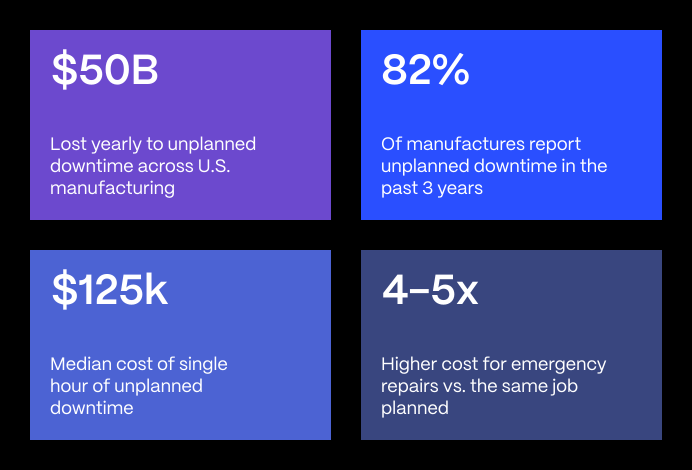
Reactive maintenance rarely looks expensive until you add it up. Across U.S. manufacturing alone, unplanned downtime is estimated to drain roughly $50 billion a year, and the pattern is widespread; the large majority of plants have dealt with at least one unplanned stoppage in the past three years, with equipment failure behind most of them, according to a global manufacturing maintenance benchmark report. A typical facility loses hundreds of hours of production annually to breakdowns that were, in hindsight, predictable. And the bill doesn’t stop at the repair invoice: emergency work, rushed parts, and idle crews routinely cost several times more than the same job done on a planned schedule.
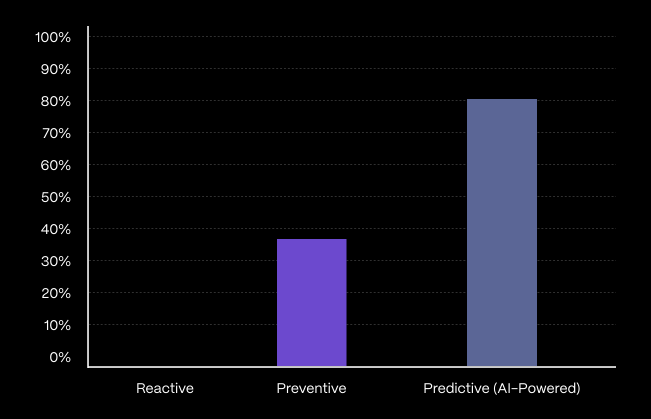
None of this is news to anyone running a plant floor, a pit, or a grid. What’s changed is the ability to see it coming. Predictive programs, built on continuous IoT sensor data and machine learning rather than fixed calendars, are now documented to cut unplanned downtime sharply once they reach maturity, while lowering overall maintenance spend at the same time.
Why this works now, not five years ago
None of this required a leap of faith a decade ago, because the economics weren’t there yet.
Vibration and thermal sensors that once cost thousands of dollars per measurement point now cost a fraction of that. Wireless, battery-powered units mean instrumenting a haul truck or a legacy motor no longer means a rewiring project. Edge computing lets a plant pre-process sensor data on-site instead of shipping every reading to the cloud, and cloud platforms now handle the terabyte-scale streams that utility-scale grids and multi-site manufacturing operations generate, without requiring an in-house data science team to manage it..
On top of that infrastructure, machine learning models trained on real failure histories, not generic physics assumptions, can recognize the specific signature of a bearing wearing out or a differential starting to fail, and the same model gets sharper with every additional site it monitors. The result: equipment health monitoring, once reserved for the highest-value assets in aerospace and process industries, is now within reach of a mid-size plant, a single mine site, or a regional utility. Technostacks has worked through exactly this kind of transition, for example, in this BLE-powered generator monitoring build that cut diagnostic time and lifted servicing productivity by 40%.
Where it hurts most
The mechanics of equipment failure look different on a stamping line, a haul road, and a substation, but the underlying pattern is the same everywhere: the warning signs exist in the data long before anyone feels them on the floor.
Heavy Manufacturing
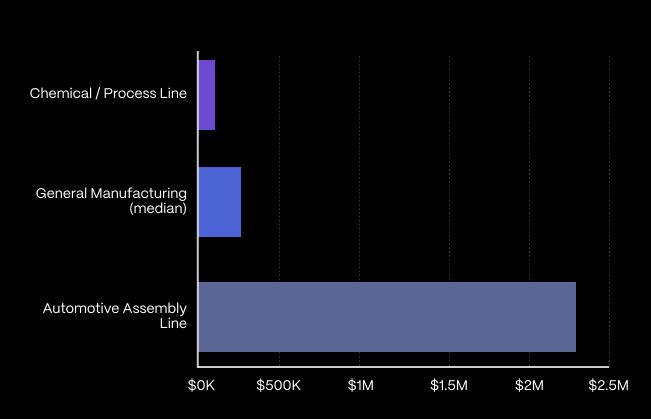
Up to $2.3M per hour, on the lines that can least afford it
High-mix, high-speed lines have the least tolerance for surprise. A failed motor, gearbox, or PLC on a tightly timed line doesn’t just stop one machine; it stops everything downstream of it. Automotive and heavy-assembly lines have reported downtime costs running into the millions per hour, and with most plants running mixed fleets of aging and newer equipment side by side, the failure modes only multiply. The pain isn’t a lack of maintenance data; most plants already run a CMMS or an ERP system. It’s that the data describes what already happened, not what’s about to happen. Technostacks’ AI-enabled ERP work with a chemical manufacturer is a good example of turning that existing operational data into forward-looking visibility instead of a historical log.
Mining
$50K–$150K per failure event, before the site even reopens
Haul trucks, draglines, and conveyors run in some of the harshest conditions any industrial asset sees: heat, vibration, and dust that accelerate wear and can mask the early signals a sensor would otherwise catch cleanly. A single gearbox or differential failure can cost well into six figures in lost production and emergency logistics, and remote sites make it worse: waiting weeks for a replacement part while a truck sits idle can turn one failure into a multi-million-dollar event. ML models trained on vibration, oil analysis, and telemetry data can now flag gearbox and differential failures 2–4 weeks in advance with 70–80% accuracy, which is exactly the lead time a remote site needs to order a part instead of expediting one.
Energy & Utilities
One weak transformer, one cascading outage
Utilities and energy operators manage assets spread across huge geographic footprints — transformers, turbines, substations, pipelines, where a single undetected fault rarely stays isolated. An overloaded, failing transformer can push load onto neighboring equipment and trigger an outage well beyond the original fault. Electrification of transport and heating is adding new peak-load stress to grids sized for yesterday’s demand, and poorly maintained renewable assets can lose a meaningful share of their output before anyone notices a problem. Technostacks’ long-range, low-power IoT monitoring work across industrial, agricultural, and solar sites reflects how this same real-time visibility need shows up on distributed energy assets. Here, the stakes go beyond cost; public safety and service continuity ride on catching degradation early.
What proactive monitoring actually looks like
Equipment health monitoring isn’t one sensor or one dashboard. It’s a loop, and it only pays off if every stage of it works.
01 / SENSE
Capture the condition
Vibration, thermal, oil-chemistry, acoustic, and electrical-signature sensors go on the assets where failure is expensive or dangerous, streaming condition data continuously instead of waiting for a scheduled inspection.
02 / STREAM
Unify the data
Edge devices filter and compress readings on-site; cloud platforms ingest and normalize them across all assets, lines, and locations into a single, consistent picture of equipment condition.
03 / PREDICT
Score asset health
Models trained on historical failure signatures score each asset’s health and estimate remaining useful life, in mature deployments, flagging developing faults one to four weeks out, often at 70-80% accuracy.
04 / ACT
Trigger the work
The output is a work order, opened automatically and routed to the right crew for the next planned window, not a report competing for attention in an inbox nobody opens.
The numbers after adoption
None of this is theoretical; it’s benchmarked across thousands of deployments in manufacturing, mining, and energy.
| Metric | Reactive Maintenance | AI-Powered Predictive Maintenance |
|---|---|---|
| Unplanned downtime | Baseline | 30–50% lower |
| Maintenance costs | Baseline | 18–25% lower |
| Equipment lifespan | Baseline | 20–40% longer |
| Cost per repair event | 4–5x planned cost | Planned-schedule cost |
| Adopters reporting positive ROI | — | 95%, with 27% inside 12 months |
Source: Predictive maintenance ROI benchmarks, McKinsey & Company / IoT Analytics, 2023–2026.
The gap between where an operation is and where it could be usually isn’t a data problem. Most heavy-industry sites already have sensors, a CMMS, or a SCADA system generating more condition data than anyone has time to read manually. The bigger gap is adoption maturity — 58% of manufacturing leaders say they’re increasing AI investment, but only about a third of maintenance teams have moved past a pilot. That gap is exactly where the advantage sits for whoever closes it first, not because the technology is scarce, but because acting on it consistently still is.
Frequently Asked Questions on Equipment Health Monitoring
What is equipment health monitoring?
It’s the practice of continuously tracking the physical condition of industrial assets, motors, gearboxes, transformers, pumps, and conveyors using sensor data such as vibration, temperature, oil chemistry, acoustics, and electrical signature, instead of relying on fixed inspection schedules or waiting for a breakdown. Paired with AI, it becomes predictive: the system doesn’t just report current condition; it forecasts when a specific asset is likely to fail.
How is this different from preventive maintenance?
Preventive maintenance services equipment on a calendar or usage-hour schedule regardless of actual condition; it replaces parts that may still have useful life, and still misses failures that don’t follow the calendar. AI-powered predictive maintenance reads live condition data and flags problems as they develop, so work happens only when the data says it’s needed, and before the failure occurs. Our related read, Industry 5.0 vs Industry 4.0, goes deeper into how this shift changes the role of the maintenance workforce, not just the tooling.
What ROI should heavy industry expect?
Documented benchmarks put unplanned downtime reductions at 30–50% and maintenance cost reductions at 18–25% for mature predictive maintenance programs, with the large majority of adopters reporting positive ROI. Actual results depend on asset criticality, failure frequency, and how consistently the maintenance team acts on the alerts the system generates. For a deeper walkthrough of the mechanics, see our guide on how AI-powered predictive maintenance reduces unplanned downtime.
Where should an operation start?
With the asset class where a single failure costs the most, in dollars, downtime, or safety risk, rather than instrumenting an entire fleet at once. A focused pilot on the highest-cost failure mode builds the internal case, and the internal trust, needed to expand monitoring across the rest of the operation.
Start with the failure that costs the most
The shift from reactive to proactive maintenance isn’t really about buying a sensor package; it’s a change in what the maintenance team does all day, moving from firefighting to forecasting. None of the three industries need to start everywhere at once. The highest-leverage move is usually the simplest: pick the asset class where a single failure costs the most, in dollars or in downtime, and build the monitoring program there first. The rest of the fleet can follow once that first deployment proves the model and the data actually work.
If you’re weighing where to start, Technostacks’ Data & AI team can help scope a pilot around your highest-cost failure mode, or you can get in touch directly to talk through your fleet.