




Why Firmware-first decisions save months

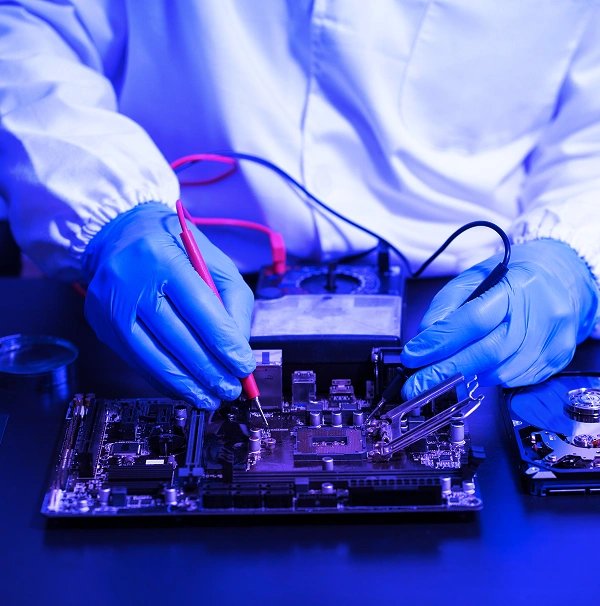
Firmware is the bridge between hardware and higher-level software — and edge timing, drivers and protocols determine what’s feasible. Solving these early avoids downstream rework, reduces field failures, and prevents costly, late-stage fixes.

80%

downstream defects originate from incorrect driver/protocol assumptions fixed too late

40%

fewer integration defects through HIL automation and reduced debug hours

35%

fewer truck rolls and site visits with OTA and signed builds

From signals to stable devices

Transform raw board signals into predictable device behavior through stable drivers, robust protocol handling, and on-device inference. Validate feasibility early with documented latency, accuracy, and power benchmarks. Establish secure telemetry and OTA pipelines to de-risk the path to pilot deployment.

Healthcare

  • Improve patient monitoring with contactless vitals using mmWave radar to capture respiration and heart rate from sub-millimeter chest motion—privacy-preserving and ideal for ICU and senior care.
  • Enhance bedside safety with resilient edge TinyML performing on-device anomaly detection for pumps, cabinets, and carts—tolerant to power or network loss, with no PHI leaving the room.

Industrial

  •  Boost assembly accuracy and compliance with vision-assisted QC rigs that guide operators and capture evidence at line speed.
  • Strengthen machine reliability through deterministic I/O control and detailed event logging for cells and production stations.

Life Sciences

  • Ensure consistent, traceable lab operations with benchtop instrument control that logs runs, calibrations, and governed releases.
  • Validate process changes safely using “twin-of-process” simulations to test cycle times, yields, and failure modes before updating SOPs.

Logistics

  • Increase equipment uptime with asset-health pilots that track run-hours, generate alerts and enable remote diagnostics for generators and field assets.
  • Improve planning accuracy with traffic and occupancy sensing prototypes that feed real-time metrics into operational dashboards.

Technical Capabilities

rapid-prototyping-and-sensors

Rapid prototyping with eval boards and quick-turn sensors & I/O

time-critical-firmware

Timing-critical firmware with Zephyr or FreeRTOS (only where needed)

on-device-ML-CV-with-TFL

On-device ML/CV with TFL-Micro, ONNX Runtime or TensorRT

protocol-bridging

Protocol bridging from Modbus/OPC UA/CAN/RS-485 to MQTT/HTTPS

various-connectivity-options

Connectivity options including Wi-Fi, Ethernet, LTE Cat-M and NB-IoT with store-and-forward

Determinism at the edge, observability everywhere

Predictable behavior

Ensure devices operate reliably under real workloads with hardened firmware and stable timing, even under load.

Safe, reversible updates

Ship OTA updates confidently during field trials with built-in safety checks and rollback paths.

Faster issue resolution

Detect and diagnose incidents quickly through end-to-end traceability of packets, logs, and device state.

Clean operational handoffs

Enable smooth transitions to internal teams and vendors with clear evidence, visibility, and documented behavior.

Bring-up to safe pilot in six steps

Targets & constraints

Define p95 latency, accuracy, power/thermal budgets, environmental limits, and risks. Establish Prototype Readiness Criteria (PRC), an experiment plan, and decision gates.

Board bring-up & drivers

Stabilize peripherals and interrupts, validate first data off the board, and create a clean HAL + driver checklist. Produce a “time-to-first-signal” log.

Protocols & edge logic

Implement resilient parsers, retry logic, back-pressure handling, and error codes; add heuristics or on-device ML when useful. Output includes the protocol test matrix, an edge state machine, and failure-mode notes.

Minimal cloud data path

Set up secure ingest, device registry, topics/schemas, alert hooks, and a basic telemetry dashboard. Deliverables include the schema map (device ↔ gateway ↔ cloud), alert rules, and observability hooks.

HIL & Hardening + Security

Build a scriptable test bench for repeatable cross-variant checks; add signed artifacts, OTA updates, and rollback support. Capture automated smoke/regression results, the signed build pipeline, OTA plan, and p95 latency/accuracy table.

Pilot pack & handover

Assemble everything required for a safe pilot: an ops runbook (install → verify → observe), acceptance criteria, ownership map, risk register, and release-notes template.

Patterns for Code That Reaches the Field

Expert insights to make you future-ready

Previous Post
Next Post

Edge wins in the wild

Touchless UV sanitation

3X

more completed cycles, 60% fewer abandoned cycles, less than 1s trigger-to-start latency, and 100% cycle logging for compliance.

LinkRead Case StudyLink

Vision-guided assembly/QC

17%

efficiency improvement and a 6.4× ROI forecast after line trials, driven by earlier defect capture and guided operator workflows.

LinkSee how we did itLink

Generator operations

25%

reduction in unplanned downtime and 30% fewer site visits through remote diagnostics and controlled field updates.

LinkRead Case StudyLink

Networked smoke detection

20%

fewer false alarms, 40% less inspection prep time, and 25% lower MTTR through centralized system status and guided troubleshooting

LinkSee how we did itLink

Got questions?
Find your answers here.

Do you write low-level drivers and bootloaders?

Plus Icon

Yes—bring-up, drivers, and bootloaders with clean HALs and versioning.

Do you handle production hardware?

Plus Icon

We handle prototype and pilot; for production runs we collaborate with your OEM/EMS and hand over specs/tests.

Can you integrate with our cloud?

Plus Icon

Yes—minimal secure ingest, registry, schemas, and alert hooks that plug into your stack.

Who owns the IP?

Plus Icon

You own custom code and artifacts; our reusable accelerators remain ours.

Can you work alongside internal and vendor teams?

Plus Icon

Absolutely—shared benches, interface reviews, and clear ownership maps.

What do you need from us to start?

Plus Icon

Target envelopes (latency/accuracy/power), sample hardware/signals, environment constraints, and a security POC.