

From Congestion to Control: How AI-Powered Vision Transformed Urban Traffic Monitoring in Australia

Scroll Down

Jump to Section
3 Min Read time
Read Time
Quick Snapshot
Technostacks deployed computer vision and generative AI to automate vehicle tracking and improve lane throughput within 4-6 weeks.
We built an AI-powered traffic monitoring system that detects, classifies, and tracks vehicles from live and recorded video feeds.
The solution delivers a centralized analytics platform with real-time visibility into: Lane utilization, Vehicle density, and Directional traffic flow.
This transformed a manual, reactive monitoring process into a proactive, data-driven system.
Challenges
Technostacks designed a modular, AI-first architecture that addressed both monitoring gaps and the underlying lane throughput challenges.
Peak-hour lane bottlenecks
Limited throughput during high-traffic periods reduced overall road efficiency.
No real-time vehicle counting
Authorities had no live visibility to respond to congestion dynamically.
Manual monitoring inefficiencies
Human observation introduced delays and increased the risk of errors.
Low-quality video input
Existing CCTV footage was often blurred or low resolution.
Inconsistent license plate formats
Variations in formats and camera angles reduced OCR accuracy.
No centralized analytics
Traffic data was fragmented, with no unified dashboard for insights.
Solution
We designed a modular, AI-first traffic monitoring architecture to solve both visibility gaps and throughput challenges.
Vision AI
Deep learning models detect cars, trucks, bikes, and buses with high accuracy.
License Plate Recognition (ANPR)
Adaptive OCR pipelines handle low-quality, angled, and multi-format plates.
Multi-Object Tracking
Tracks vehicles across frames with Persistent IDs, Entry/exit zone detection, and Directional flow analysis.
GenAI Insights
Integration with AI tools like GPT and Google Gemini, which enable automated reports and natural language traffic summaries.
Real-Time Dashboard
Live visualization of Vehicle counts, Density heatmaps, and Traffic flow direction, along with exportable insights by time and location.
Backend System
Built using FastAPI with async pipelines. Handles large-scale video processing and API communication.
Technologies Used
A purpose-built stack combining production-grade ML frameworks with scalable infrastructure:
Python 3.9+
PyTorch
OpenCV
FastAPI
GPT (OpenAI)
Google Gemini
Ultralytics
NVIDIA CUDA
NVIDIA RTX 3060+
Cloud Storage
Custom Web Dashboard
Impact
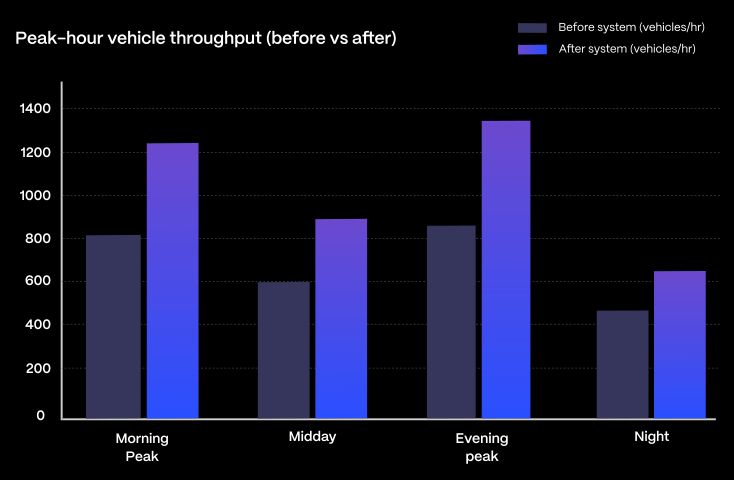
Authorities gained their first real-time view of peak-hour lane performance, enabling smarter signal timing, dynamic lane allocation, and faster incident response. Operations shifted from reactive reporting to proactive traffic optimization.
Conclusion
In six weeks, Technostacks transformed a congestion-heavy corridor into a smart, AI-driven traffic system. The solution directly addressed the key goal of improving vehicle throughput during peak hours by combining computer vision, multi-object tracking, and generative AI. The platform goes beyond monitoring; it provides actionable intelligence for smarter city decisions.
Ready to Transform Your Traffic Monitoring with AI?
If you’re planning to modernize traffic systems, improve vehicle tracking, or gain real-time mobility insights, our AI experts can help you design, deploy, and scale intelligent monitoring solutions with precision.
Our Solutions in Action
-
Software & Platforms • Cloud & DevOps • Digital Products • Product Engineering: A Land Parcel and Stakeholder Management Platform for a Land Services Software Company

A Land Parcel and Stakeholder Management Platform for a Land Services Software Company
The platform brings parcel mapping, stakeholder engagement, and project operations onto one system for a Calgary-based land, stakeholder, and project management software company, replacing s…
-
Software & Platforms • Cloud & DevOps • Digital Products • Internet of Things (IoT) • Product Engineering: A Map-First Geospatial Platform for Drone, Seedcane and Field Operations
A Map-First Geospatial Platform for Drone, Seedcane and Field Operations
Sense SaaS brings farm and site operations onto one map. Landowners order drone and lab services against mapped fields, growers manage certification and yield programmes, and field teams cap…
-
Real Estate • Cloud & DevOps • Data & AI • Digital Products • Product Engineering: Automated Utility Bill Data Extraction for Property Portfolios
Automated Utility Bill Data Extraction for Property Portfolios
BillSlayer reads electricity, water, refuse, and municipal rates bills on its own and turns them into live cost dashboards. Owners forward a bill by email, WhatsApp, or web upload, and the n…

-
Real Estate • Data & AI • Digital Products • Product Engineering: From Fragmented Systems to One Dashboard: A PropTech Platform for Modus10
From Fragmented Systems to One Dashboard: A PropTech Platform for Modus10
Modus10 (a South Africa-based property management firm) now runs leasing, utilities, access control, and tenant services from a single dashboard, replacing the paperwork and disconnected sys…

-
Industrial • Data & AI • ERP • Generative AI: From Stuck to Resolved: An AI Agent for ERP Exception Resolution
From Stuck to Resolved: An AI Agent for ERP Exception Resolution
Turning ERP exceptions into explanations and recommended fixes.

-
Real Estate • ERP: From Spreadsheets to a Single Source of Truth: Custom Real Estate CRM and HRMS Platform – Part 1
From Spreadsheets to a Single Source of Truth: Custom Real Estate CRM and HRMS Platform – Part 1
Imagine a broker checking unit availability in one spreadsheet, calculating brokerage in a second, hunting for the signed agreement in a shared drive, and messaging HR separately to log a re…

-
Industrial • Data & AI • ERP • Generative AI: AI-Powered ERP Automation for Predictive Supply Chain & Inventory
AI-Powered ERP Automation for Predictive Supply Chain & Inventory
From reactive ERP reports to predicted, human-approved reorders.
-
Industrial • Data & AI • ERP • Generative AI: From Emails to ERP Transactions: AI-Powered Order Processing for Unstructured Requests
From Emails to ERP Transactions: AI-Powered Order Processing for Unstructured Requests
A one-line email asking to ship 500 units becomes a validated ERP sales order, read, matched to the right customer and material, and entered without anyone retyping a thing.
-
Industrial • Data & AI • ERP • Generative AI: AI-Powered Procurement Automation for Manufacturing
AI-Powered Procurement Automation for Manufacturing
How AI Eliminated Manual Procurement Across Manufacturing Ops

Lets Talk
Have a challenge?Let us know.