

30% Fewer Stockouts. 25% Less Overstock. One AI Forecasting Engine.

Scroll Down

Jump to Section
3 Min Read time
Read Time
Quick Snapshot
A leading tools and equipment retailer struggled with erratic inventory cycles due to demand unpredictability. By deploying advanced forecasting models, such as Random Forest and XGBoost—trained on weekly sales trends—we helped them automate predictions, reduce overstocking, and improve revenue retention.
Brief
Inventory is capital in boxes—too little, and you lose sales; too much, and margins bleed. Northern Tools faced the classic challenge: predicting demand across hundreds of SKUs with variable sales patterns and limited inventory data. Sales anomalies, seasonal swings, and product diversity made manual planning unreliable and time-consuming.
To cut through this complexity, Technostacks implemented an AI-powered forecasting engine that decoded past trends and predicted future sales with unmatched accuracy.
The result?
Smoother stock levels, fewer backorders, and higher revenue retention lower costs.
Challenges
Limited Inventory Visibility
Only aggregate stock data was available—no granular, time-stamped movement at SKU level—making it hard to track true availability or identify stockout-driven dips in demand.
Lack of Real-Time Demand Signals
The retailer relied heavily on weekly sales snapshots, which couldn’t capture demand surges during promotions or weather-driven events. This lag between market activity and system awareness led to missed opportunities and reactive stocking.
Complex, Non-Linear Demand
Seasonality and erratic spikes made standard time-series methods unreliable. Each SKU needed customized windows and decomposition logic.
High Product Variability
Diverse sales behaviors across SKUs meant a single-model strategy fell flat—requiring a modular, product-specific approach.
Solution
We built a robust forecasting pipeline by combining time-series modeling with tree-based machine learning, tailored to each product’s behavior.
Feature
Engineering
Introduced lag-based variables, rolling stats, and seasonality markers to capture short-term spikes and long-term patterns.
Model
Training
Evaluated and optimized multiple ML models (Random Forest, XGBoost, and LightGBM) to benchmark predictive performance.
Advanced
Validation
Used MAE, RMSE, and R² scoring to track model accuracy, while ranking feature importance to refine forecasting logic.
Deployment at
Scale
Integrated forecasting outputs to support real-time inventory decisions—ready for peak sales, flash promos, or quiet seasons.
Impact
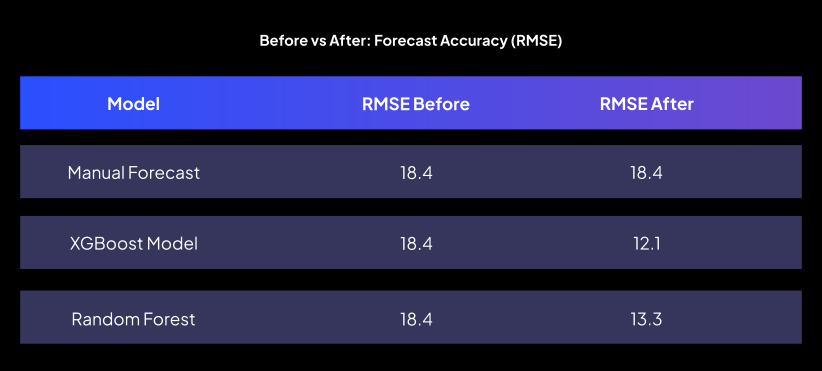
RMSE (Root Mean Square Error) measures how close your model’s predictions are to actual outcomes.
Lower RMSE = Higher Accuracy. These results reflect measurable, data-backed gains in forecasting precision.
Ready to make your inventory decisions less reactive and more predictive?
See how AI can move your planning from the warehouse whiteboard to real-time, revenue-driven intelligence.
Our Solutions in Action
-
Industrial • Data & AI • ERP • Generative AI: AI-Powered ERP Automation for Predictive Supply Chain & Inventory

AI-Powered ERP Automation for Predictive Supply Chain & Inventory
From reactive ERP reports to predicted, human-approved reorders.

-
Industrial • Data & AI • ERP • Generative AI: From Emails to ERP Transactions: AI-Powered Order Processing for Unstructured Requests
From Emails to ERP Transactions: AI-Powered Order Processing for Unstructured Requests
A one-line email asking to ship 500 units becomes a validated ERP sales order, read, matched to the right customer and material, and entered without anyone retyping a thing.
-
Industrial • Data & AI • ERP • Generative AI: AI-Powered Procurement Automation for Manufacturing
AI-Powered Procurement Automation for Manufacturing
How AI Eliminated Manual Procurement Across Manufacturing Ops
-
Real Estate • ERP: One Platform, Every Stage: A Connected ERP for the Complete Property Development Lifecycle
One Platform, Every Stage: A Connected ERP for the Complete Property Development Lifecycle
One ERP for Land, Construction, Sales, Finance & Delivery

-
Industrial • ERP • Product Engineering: From Walk-In to Delivery: Digitizing Eyewear Retail Operations
From Walk-In to Delivery: Digitizing Eyewear Retail Operations
One ERP from Walk-In & Prescription to Factory & Delivery

-
Industrial • Digital Products • Product Engineering • Strategic Consulting: Modernizing Chemical Manufacturing with ERPNext & SAP Migration
Modernizing Chemical Manufacturing with ERPNext & SAP Migration
Custom ERPNext solution for smarter chemical manufacturing operations

-
Renewable • Digital Products • Product Engineering • Strategic Consulting: Enabling Scalable Solar Operations with Zoho One
Enabling Scalable Solar Operations with Zoho One
Discover how Technostacks implemented a unified Zoho One ecosystem to streamline customer management, field service, finance, and solar site operations for a fast-growing renewable energy co…

-
Industrial • Digital Products • ERP: Digitizing EV Charger Manufacturing with a Smart ERP Platform
Digitizing EV Charger Manufacturing with a Smart ERP Platform
Imagine predicting product demand with laser precision—cutting holding costs, optimizing stock levels, and boosting revenue, all while saying goodbye to guesswork.

-
Logistics • Data & AI: A Multi-Agentic Enterprise Solution by Technostacks
A Multi-Agentic Enterprise Solution by Technostacks
The Enterprise AI Platform is a next-generation solution that automates complex business processes, enhances operational efficiency, and enables intelligent decision-making. Powered by a Mul…


Lets Talk
Have a challenge?Let us know.