

AI-Powered Chromatogram Analysis for Faster Laboratory Testing

Scroll Down

Jump to Section
3 Min Read time
Read Time
Quick Snapshot
A U.S.-based testing laboratory struggled with time-consuming chromatogram analysis, manual corrections, and inconsistent first-level reviews. Technostacks developed an AI-powered chromatogram analysis solution trained on 5,000+ historical reviews, reducing review time by 70% and increasing sample throughput by 2× without additional staff.
Brief
In regulated testing environments, accuracy isn’t a luxury—it’s the baseline. However, ensuring precision comes at the cost of time. In this case, a lab faced a familiar bottleneck: analysts were spending close to 1.5 hours per sample reviewing chromatograms manually—a tedious process that involved identifying peaks, correcting noise, adjusting for co-elutions, and ensuring every tiny anomaly was accounted for. These reviews were then passed on to a second-level reviewer, further stretching the turnaround.
With AI stepping into the workflow, things changed dramatically. Built using historical review data, our AI model learned how analysts performed corrections and began replicating those decisions. It handled the repetitive, error-prone first-level review in minutes, not hours.
Challenges
Operational Bottleneck
Each sample required 60–90 minutes of review time. This meant a single analyst could only process about 6 samples in an 8-hour shift, significantly limiting the lab’s testing capacity. Clients were often waiting over 72 hours for test results due to backlog and analyst fatigue.
Matrix Interference Issues
Food and cannabis products often come with complex matrices (e.g., sugars, fats, flavourings) that interfere with accurate compound detection. Analysts frequently had to correct for enhancements, suppression, or co-eluted peaks manually.
Inconsistent Review Quality
Different analysts applied slightly different criteria when correcting chromatograms. This led to inconsistencies in reporting and flagged several unnecessary outliers for second-level review.
Solution
We trained an AI engine on 5000+ analyst-reviewed chromatograms and integrated it directly into the first-level review workflow. It resulted in :
Baseline
Corrections
Automatically smooths noisy baselines by learning real-world noise patterns.
Retention Time
Adjustments
Adjusted for small RT shifts due to instrument variability, ensuring peaks appeared at expected locations.
Matrix Interference
Corrections
Recognized common suppression/enhancement patterns from sample types like gummies or beverages and auto-corrected them.
Peak Integration
and Separation
Identified overlapping peaks and accurately split them where needed to reflect the real compound presence.
Impact
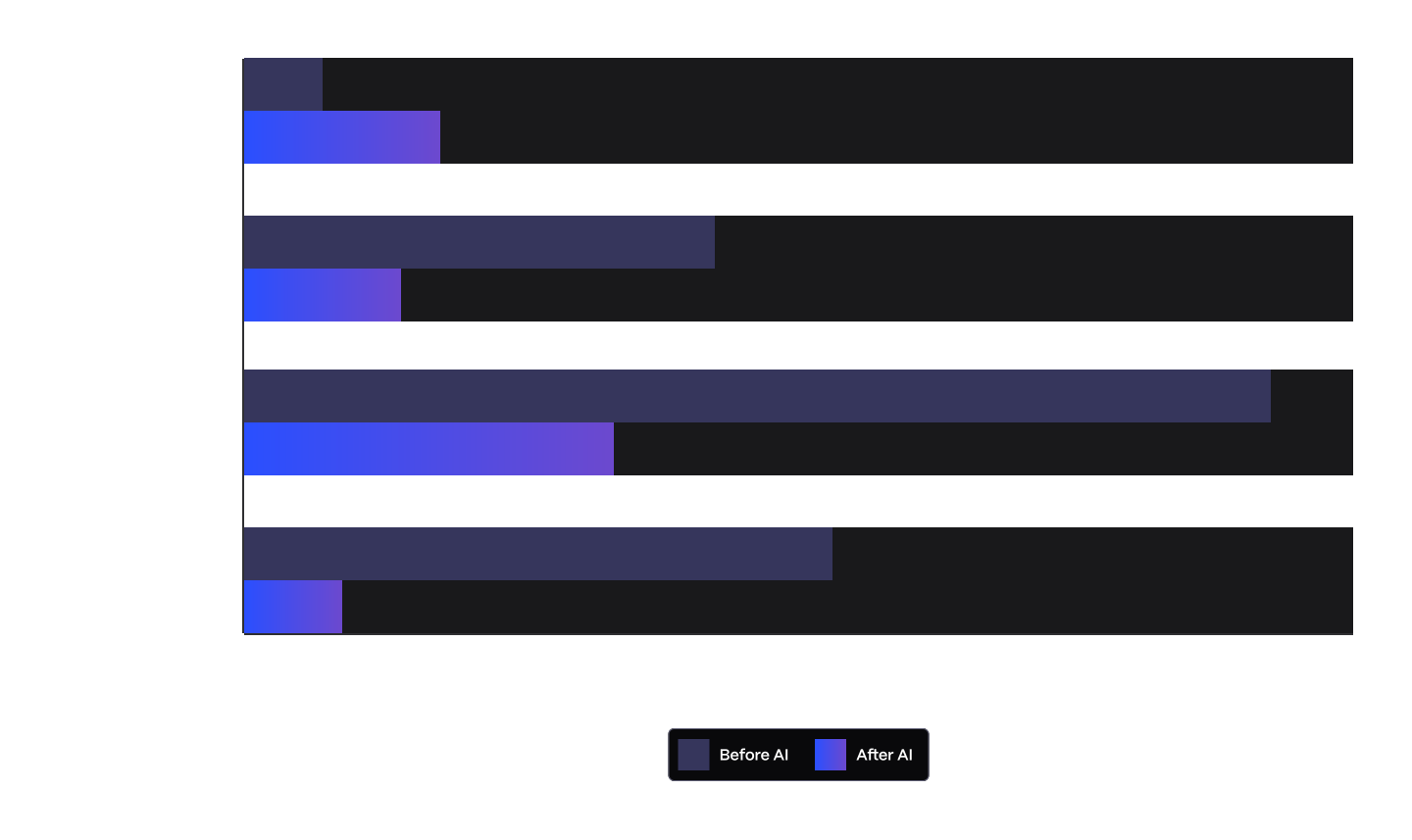
“AI model trained on 5,000+ historical reviews replicates your analysts’ judgment.”
Meet Maya
Before AI
Maya, one of the lab’s senior analysts, could review around 6 cannabis gummy samples in a full day. Each required her to manually inspect noisy chromatograms, flag overlapping peaks, and struggle with matrix interferences caused by sugar and flavoring agents. By 4 PM, she would be exhausted, with more samples still waiting. With fatigue, her each subsequent review went slower and was more error-prone.
After AI
With our AI engine in place, Maya arrives to find 12 pre-reviewed chromatograms waiting in her queue. She only needs to validate the AI’s decisions—a quick 10 minute check per sample. She spends the rest of the day either clearing more complex samples or assisting junior analysts. For the lab, this means double the output without doubling the headcount. The same instruments. The same team. Just smarter workflows.
Ready to transform
your lab’s operations?
Let’s set up a 30-minute demo to learn.
How AI can cut turnaround time and boost ROI—no new hires required.
Our Solutions in Action
-
Software & Platforms • Cloud & DevOps • Digital Products • Product Engineering: A Land Parcel and Stakeholder Management Platform for a Land Services Software Company

A Land Parcel and Stakeholder Management Platform for a Land Services Software Company
The platform brings parcel mapping, stakeholder engagement, and project operations onto one system for a Calgary-based land, stakeholder, and project management software company, replacing s…

-
Software & Platforms • Cloud & DevOps • Digital Products • Internet of Things (IoT) • Product Engineering: A Map-First Geospatial Platform for Drone, Seedcane and Field Operations
A Map-First Geospatial Platform for Drone, Seedcane and Field Operations
Sense SaaS brings farm and site operations onto one map. Landowners order drone and lab services against mapped fields, growers manage certification and yield programmes, and field teams cap…

-
Real Estate • Cloud & DevOps • Data & AI • Digital Products • Product Engineering: Automated Utility Bill Data Extraction for Property Portfolios
Automated Utility Bill Data Extraction for Property Portfolios
BillSlayer reads electricity, water, refuse, and municipal rates bills on its own and turns them into live cost dashboards. Owners forward a bill by email, WhatsApp, or web upload, and the n…

-
Real Estate • Data & AI • Digital Products • Product Engineering: From Fragmented Systems to One Dashboard: A PropTech Platform for Modus10
From Fragmented Systems to One Dashboard: A PropTech Platform for Modus10
Modus10 (a South Africa-based property management firm) now runs leasing, utilities, access control, and tenant services from a single dashboard, replacing the paperwork and disconnected sys…

-
Industrial • Data & AI • ERP • Generative AI: From Stuck to Resolved: An AI Agent for ERP Exception Resolution
From Stuck to Resolved: An AI Agent for ERP Exception Resolution
Turning ERP exceptions into explanations and recommended fixes.

-
Real Estate • ERP: From Spreadsheets to a Single Source of Truth: Custom Real Estate CRM and HRMS Platform – Part 1
From Spreadsheets to a Single Source of Truth: Custom Real Estate CRM and HRMS Platform – Part 1
Imagine a broker checking unit availability in one spreadsheet, calculating brokerage in a second, hunting for the signed agreement in a shared drive, and messaging HR separately to log a re…

-
Industrial • Data & AI • ERP • Generative AI: AI-Powered ERP Automation for Predictive Supply Chain & Inventory
AI-Powered ERP Automation for Predictive Supply Chain & Inventory
From reactive ERP reports to predicted, human-approved reorders.

-
Industrial • Data & AI • ERP • Generative AI: From Emails to ERP Transactions: AI-Powered Order Processing for Unstructured Requests
From Emails to ERP Transactions: AI-Powered Order Processing for Unstructured Requests
A one-line email asking to ship 500 units becomes a validated ERP sales order, read, matched to the right customer and material, and entered without anyone retyping a thing.
-
Industrial • Data & AI • ERP • Generative AI: AI-Powered Procurement Automation for Manufacturing
AI-Powered Procurement Automation for Manufacturing
How AI Eliminated Manual Procurement Across Manufacturing Ops

Lets Talk
Have a challenge?Let us know.