

The Rise of the AI Workforce: How Multi-Agent Systems Will Reshape Business Operations by 2027
The numbers moved fast. The multi-agent AI market reached $6.25 billion in 2025 and is projected to hit $146.21 billion by 2035, a 37% compound annual growth rate driven almost entirely by enterprises realising that single agents hit their limits quickly.
Most early AI deployments were isolated: one chatbot for support, one script for data entry, one model for document search. Useful, but separate. What’s changing now is orchestration. Multi-agent systems let specialized AI agents collaborate, hand off tasks, and execute across CRM, ERP, and internal tools in coordinated loops, the way a human team does, but without the handoff delays.
This article maps where that shift is happening across the enterprise, customer support, IT operations, analytics, document processing, and cross-functional workflow automation, and provides a framework for identifying where an agentic AI deployment will actually deliver measurable value in your organization.
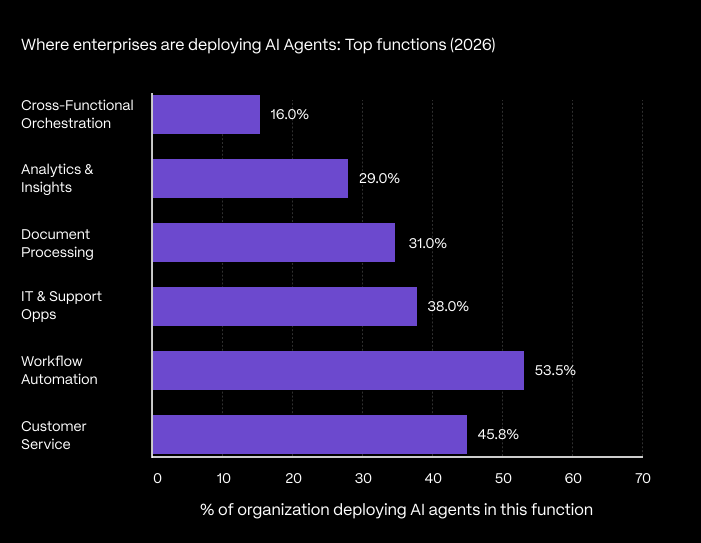
83% of business leaders believe AI agents will outperform humans in repetitive, rule-based tasks. Only 16% have agents running across cross-functional processes today, which is exactly where the competitive gap is opening. (Anthropic Enterprise Report, 2026)
Why Single Agents Aren’t Enough: The Case For Multi-Agent Systems
A single AI agent can resolve a support ticket, write a summary, or query a database. What it can’t do is run parallel tasks, specialize deeply across domains, and bridge multiple systems simultaneously. That’s the architectural ceiling most organizations hit after their first deployment.
Multi-agent systems solve this by assigning a lead orchestrator agent and multiple sub-agents, each optimized for a specific role. Anthropic’s internal research demonstrated this precisely: a lead agent planning strategy while sub-agents gather data in parallel outperformed single-agent benchmarks by 90.2%. The coordination overhead is real, but the performance ceiling is far higher.
The deployment picture reflects this. According to Forrester and Gartner, 2026 is the breakthrough year for multi-agent enterprise systems, a shift from experimental single-agent pilots toward production multi-agent orchestration. Enterprise workflow automation already commands the largest application share at 24.7% of the market.
Customer Support & It Operations: The Highest-Volume Entry Points
Customer support and IT helpdesk automation are where most enterprises start, and for good reason. Both functions have what agentic AI needs to work well: high volume, structured intent categories, accessible data, and a clear definition of “resolved.”
On the customer side, AI agents now handle routine inquiries, order tracking, dynamic troubleshooting, and FAQ resolution autonomously, end to end, without a human in the loop. Gartner predicts that agentic AI will autonomously resolve 80% of common service issues without human intervention by 2029. Early production deployments are already reaching 80-93% autonomous resolution rates. The cost arithmetic is striking: a contained customer service ticket costs $0.46 to resolve via AI versus $4.18 handled by a human, a 9x reduction per Forrester TEI analysis.
The key design decision is intent classification. AI agents score highest on structured intents, password resets, refund status, and lowest on sentiment-heavy ones like complaint handling. Deploying agents on the wrong intent categories without a fast escalation path is a CSAT liability, not a productivity win. The right architecture: autonomous AI for 40-60% of volume, agent-assist for human-handled cases, and clear escalation for complex situations.
IT helpdesk follows the same pattern. Tier-1 tickets, password resets, system status queries, access requests, and tech stack guidance are high in volume and low in variance. An agent handling these doesn’t just save developer time; it responds faster. For development teams spending hours per week on internal IT questions, that reallocation toward architecture, security, and product work is the actual value.
Analytics & Management: From Dashboards To Predictive Action Plans
Most analytics tools show what happened. They compare last quarter to this quarter, flag a dip in conversion, and surface an anomaly in churn. The insight sits in a chart. The decision still happens in a meeting.
Agentic AI closes that gap. Rather than waiting for a human to review dashboards, an analytics agent can be configured to continuously compare prior-week performance data against current metrics, identify the specific workflow or team responsible for the deviation, and generate a forward-looking action plan, not a description of the problem, but specific recommended steps to address it.
The practical difference: a dashboard tells a CRO that lead conversion dropped 12% last week. An analytics agent tells them that conversion dropped in the mid-market segment, that the drop correlates with a 3-day increase in response time from two specific reps, that response time increased because those reps were pulled into onboarding tasks, and that reassigning onboarding coverage would likely recover the shortfall within 10 business days.
This is what “predictive action” means in practice: not a forecast, but an executable recommendation grounded in process data. For CXOs managing multiple functions, this changes the AI workforce management dynamic: agents that surface bottlenecks and prescribe interventions compress the feedback loop between data and decision considerably.
Operations & Legal: Intelligent Document Processing At Scale
Document-heavy processes are some of the most expensive to run manually and some of the most amenable to agentic automation, not because the documents are simple, but because the extraction logic is consistent.
| Department | Agent function | Human role shifts to |
|---|---|---|
| Customer Support | Resolve routine inquiries, track orders, answer FAQs autonomously | Complex complaints, retention, relationship escalation |
| IT Helpdesk | Tier-1 tickets, password resets, system status queries, stack guidance | Architecture decisions, security incidents, vendor evaluation |
| Analytics | Compare week-on-week metrics, flag anomalies, generate action plans | Interpreting strategic signals, challenging model assumptions |
| Operations / Legal | Extract metrics, draft summaries, validate warranties, parse claims | Judgment calls on contested cases, regulatory decisions |
| Enterprise Workflows | Orchestrate CRM → ERP loops, route approvals, execute conditional steps | Process design, exception handling, governance oversight |
Three areas where document-processing agents deliver measurable lift:
Reports and proposals
- Agents extract key metrics from structured data sources and draft or summarize complex proposals and executive status reports. The agent doesn’t replace the analyst; it eliminates the data assembly work that precedes analysis, often 2-4 hours per report cycle.
Warranty and guarantee validation
- Agents validate warranty timelines, terms, and purchase proof across consumer and enterprise records automatically. A claim that required a human to cross-reference three systems and 20 minutes of manual lookup becomes a sub-60-second automated check.
Claims processing
- Agents parse insurance, vendor, or reimbursement claim forms, verify document completeness, flag missing fields, and route verified claims for approval. This is the use case with some of the clearest ROI: one regional insurance carrier documented a 62% reduction in claims processing time after deploying an agentic document pipeline.
The failure mode we consistently see: teams deploy a document-processing agent on their messiest, most exception-heavy workflow first. That’s the wrong starting point. Start with the workflow that’s high-volume and structurally consistent, claims verification, warranty validation, before targeting the complex edge cases. The pilot builds the template; the template enables the scale.
Enterprise-Wide Orchestration: Bridging Crm, Erp, And Internal Tools
The most consequential deployments aren’t agents that handle single tasks well. They’re multi-agent systems that bridge the systems organizations already run, CRM, ERP, ITSM, finance platforms, into execution loops that don’t need human coordination at every handoff.
A sale closes in the CRM. An orchestrator agent reads the deal, triggers fulfilment tasks in the ERP, creates a customer record in the billing system, assigns onboarding steps to the right team in the project tool, and sends the customer a welcome sequence, all without a single manual data entry step. This is cross-functional orchestration in its operational form.
Beyond automation, multi-agent systems enable deep process analysis: agents that track workflow velocity across departments, identify which steps are consistently slow or error-prone, auto-route tasks to the appropriate handler based on workload and priority, and execute conditional multi-step approvals with defined escalation logic. According to Salesforce’s 2026 Connectivity Report, 50% of AI agents still operate in isolated silos rather than as part of a coordinated system, which means the organizations that have moved to multi-agent orchestration have a structural advantage that isolated deployers can’t quickly close.
How To Identify Where To Start: An Implementation Framework
The most common mistake in agentic AI implementation isn’t technical. It’s starting too broad. Organizations that try to automate enterprise-wide processes before proving a single workflow create complexity they can’t govern, costs they can’t justify, and failure modes they haven’t mapped.
The framework that works starts narrow and scales from a proven template.
Step 1:
- Audit for pain points. Map every repetitive manual task, slow response loop, or document-heavy process across a single department. Look specifically for: tasks that take the same steps every time, workflows with high error rates from human data entry, processes where response time is a known complaint, and document handling that requires cross-referencing multiple systems.
Step 2:
- Apply the fit assessment. Not every workflow is ready for agentic AI. The table below gives the signal set to evaluate each candidate:
| Signal | Ready for agentic AI | Not yet ready |
|---|---|---|
| Data availability | Structured, accessible, consistent records | Scattered across systems, incomplete, or siloed |
| Process repeatability | Steps follow predictable logic >80% of the time | Highly variable, judgment-dependent at every stage |
| Volume | High volume, hundreds of instances per week | Low volume, manual handling is still manageable |
| Error cost | Errors are recoverable, detectable, measurable | Errors carry legal, financial, or safety consequences before validation |
| Integration points | API access to source systems exists or is buildable | Legacy systems with no API layer |
Step 3:
- Pick one high-confidence target. Customer FAQ automation, IT ticket deflection, and claims document parsing are common strong starting points because they score well across most of the fit criteria above: structured data, high volume, predictable logic, and measurable outcomes.
Step 4:
- Pilot with defined success metrics. Run the agent against the selected workflow for 4-6 weeks with a baseline established before launch: volume handled, error rate, average handling time, escalation rate. The pilot output is a deployment template, not just a result.
The implementation roadmap below shows the full sequence:
| Phase | Action | Output |
|---|---|---|
| 1. Audit | Map all repetitive manual tasks, slow loops, and document-heavy processes across one department | Shortlist of 5-10 candidate workflows |
| 2. Score | Apply the fit assessment table: data availability, volume, repeatability, error cost, integration | Ranked list with 1-2 high-confidence targets |
| 3. Pilot | Deploy a single agent on the top-ranked use case with defined success metrics | Live baseline: volume handled, error rate, time saved |
| 4. Evaluate | Measure against baseline after 4-6 weeks; identify edge cases and escalation gaps | Refined agent + documented failure modes |
| 5. Scale | Expand to adjacent workflows using pilot learnings as the deployment template | Multi-agent orchestration across the department |
Median payback for a well-scoped customer service AI agent deployment is 4.1 months. That timeline assumes governance is built in from the start, escalation paths are defined, output monitoring is in place, and edge cases are documented. Without that structure, deployments that work in pilot fail at scale because the failure modes only emerge at volume.
What 2027 Looks Like, And What To Do Before It Arrives
By 2027, IDC expects AI copilots to be embedded in nearly 80% of enterprise workplace applications. The organizations ahead of that curve aren’t the ones with the most sophisticated agents. They’re the ones that started narrow, proved a workflow, and built a deployment template that scales.
The competitive gap between organizations running coordinated multi-agent systems and those still running isolated experiments will close, but it’s a gap that takes 12-18 months to cross from a standing start. The time to start that pilot isn’t after your competitors have proven the case.
If you’re mapping where agentic AI fits in your operations, talk to our team or explore how we’ve built multi-agent enterprise systems for production deployments.
Frequently Asked Questions
1. What is an AI workforce, and how is it different from traditional automation?
An AI workforce refers to networks of autonomous AI agents that handle end-to-end business tasks, not just trigger rules. Unlike traditional automation, which executes fixed scripts, AI agents reason across context, take multi-step actions, and adapt when conditions change.
2. What are multi-agent systems and why do enterprises need them?
Multi-agent systems are architectures where multiple AI agents, each specialized for a specific task, collaborate toward a shared goal under an orchestrator. A single agent can’t run parallel tasks, specialize deeply, or bridge multiple systems simultaneously. Multi-agent systems solve this: Anthropic’s research shows lead-agent-plus-sub-agents outperform single-agent benchmarks by 90.2%. See our guide to building agentic AI applications for architecture details.
3. Which business functions benefit most from agentic AI?
Customer support and workflow automation lead current enterprise deployments; 45.8% and 53.5% of organizations are deploying agents there, respectively (WotNot, 2026). IT operations, document processing, and cross-functional orchestration follow. The highest ROI typically comes from functions with high volume, structured data, and predictable process steps. For a logistics-specific example, see how agentic AI is reshaping last-mile logistics.
4. How should a company decide where to start with multi-agent AI?
Start with one high-impact, data-rich, repetitive workflow rather than a broad enterprise rollout. Common strong entry points: customer FAQ automation, IT ticket deflection, and claims document parsing. Assess readiness using data availability, process repeatability, volume, error cost, and integration access. A pilot against a single workflow produces a repeatable deployment template that scales faster than building enterprise-wide from day one.
5. What does AI workforce management look like in practice?
AI workforce management means defining clear roles for agents, setting measurable KPIs, building human escalation paths, and auditing agent outputs regularly.