Why Data Cleaning Is the First Step in Every Enterprise AI Project
Most enterprise AI projects don’t fail in the model. They fail before the model ever sees good data. Data cleaning, deduplicating records, standardizing formats, fixing missing or inconsistent values, sounds like the boring part of an AI initiative. In practice, it’s the part that decides whether the project ever produces a usable result.
Gartner puts a hard number on it: 85% of AI projects that fail cite poor data quality as a root cause, and only 12% of organizations have data of sufficient quality to support AI applications in the first place. Business owners evaluating an AI or data cleaning partner aren’t choosing between “clean data” and “faster results.” Skipping data cleaning is usually what causes the slower, more expensive outcome.
The Real Cost of Skipping Data Cleaning
The financial case is not subtle. Gartner estimates that poor data quality costs organizations an average of 15% of revenue every year, and that up to 40% of AI project costs come from fixing data issues only caught after deployment, after the model was already built and put in front of users. Fixing dirty data after go-live is always more expensive than cleaning it first, because by then it isn’t just a data problem; it’s a data problem wrapped in a rebuild.
This is also why Gartner predicts 60% of AI projects lacking AI-ready data will be abandoned before they reach production.
The pattern repeats across industries: a pilot looks promising on a small, clean test set, then stalls the moment it meets the real, messy data every enterprise actually has.
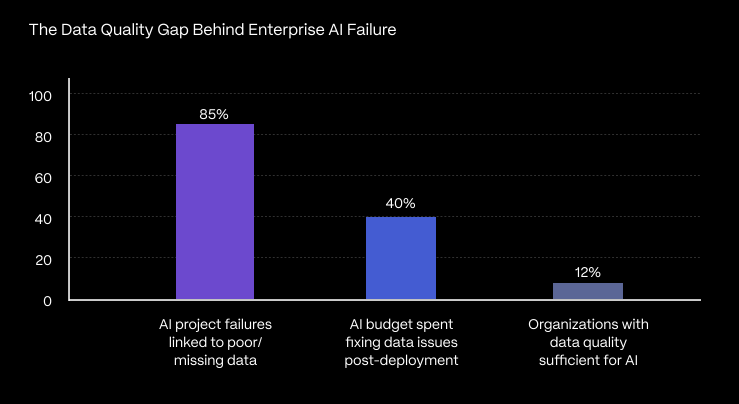
Source: Gartner 2025; Informatica 2025 CDO insights survey
Why Business Owners Underestimate This Step
It’s an easy step to underestimate, because data cleaning rarely shows up on a roadmap as its own line item; it gets folded into “data prep” and treated as overhead standing between the business and the “real” AI work. In reality, it is the work. The pain points are familiar to almost every decision-maker who has scoped a data or AI initiative:
- Duplicate and conflicting customer records across CRM, billing, and support systems
- Inconsistent formats between departments, dates, currencies, and product codes that don’t match
- Missing or incomplete fields from years of manual data entry
- Legacy systems and data silos that were never built to talk to each other
- Unstructured data: PDFs, emails, scanned documents, never normalized into anything a model can use
None of these are exotic. They’re the ordinary residue of running a business for more than a few years, and 92.7% of executives now name data itself as the biggest barrier to getting AI to work.
Automated Pipelines vs. Manual Spreadsheets:
Speed Without the Bottleneck: A common reason decision-makers hesitate to prioritize data cleaning is the fear of timelines, worrying it means months of tedious, manual labor. In modern enterprise environments, that is a myth.
Data cleaning is no longer people manually editing rows in a spreadsheet; it is an engineered, automated pipeline. Modern Data & AI architectures use machine learning algorithms for fuzzy matching and deduplication, automated schema validation to fix formatting instantly, and AI-driven parsing tools to turn messy PDFs and unstructured files into clean, machine-readable datasets in days rather than months.
What “AI-Ready Data” Actually Requires
“Clean data” is a specific, checkable standard, not a vague quality bar. A useful way to see the gap:
| Raw Enterprise Data | AI-Ready Data |
|---|---|
| Duplicate customer/vendor records | Deduplicated, single source of truth |
| Inconsistent date, currency, unit formats | Standardized formats across all systems |
| Missing or null values | Validated, flagged, or systematically filled |
| Siloed across departments and tools | Integrated into a unified data pipeline |
| No access or ownership rules | Governed with clear data ownership and access control |
| Unstructured documents and files | Structured, labeled, and machine-readable |
This is the layer that a Data & AI engagement is actually built around, cleaning, integrating, and governing the data before a model is trained on it, not after a pilot underperforms. It’s the same discipline behind Technostacks’ ERP and data consolidation work with a chemical manufacturer: the operational gains came from fixing the underlying data, not from the software layered on top of it.
The ROI Case for Cleaning Data First
The return on this work is not marginal. Enterprises with strong data integration report 10.3x ROI on AI initiatives, versus 3.7x for those with poor data connectivity, nearly three times the return from the same AI investment, based purely on whether the data was clean and integrated. Industry benchmarks also suggest that for every dollar spent on data quality, enterprises save roughly 5-10x in avoided failures, rework, and compliance costs.
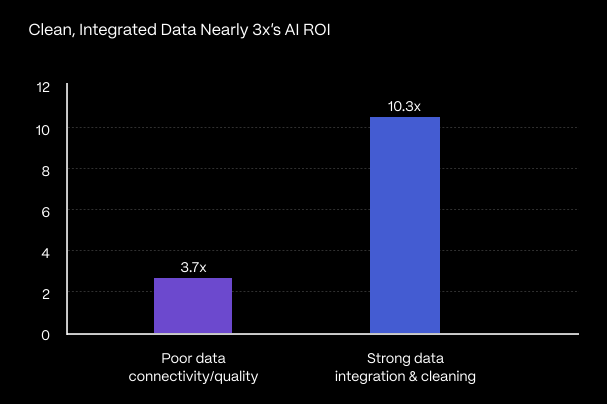
Source: MIT NANDA / Folio3 AI enterprise ROI research,2026
That gap compounds as agentic AI scales, too, as agent adoption quadrupled in recent enterprise surveys; the share of leaders citing data quality as their top barrier jumped from 56% to 82% in the same period. See our related work on multi-agentic enterprise AI for how this plays out when agents run on properly cleaned data from the start.
What to Ask Before Your Next AI Project Starts
For a business owner scoping an AI initiative, the highest-leverage question isn’t “which model should we use”; it’s “what does our data cleaning phase look like, and how long does it take?” Ask a prospective partner:
- What share of the timeline is allocated to data cleaning and validation, not model work?
- How will duplicate, missing, and inconsistent records be resolved?
- Who owns data governance once the project moves into production?
Without clear answers, the project is at real risk of joining the 85% of failures caused by data that was never AI-ready.
The Takeaway
Data cleaning isn’t the delay before the AI project starts; it’s the first and most decisive phase of the project itself. The enterprises seeing real ROI from AI aren’t the ones with the newest models; they’re the ones that treated their data as the foundation, not an afterthought. If you’re scoping an enterprise AI initiative, Technostacks’ Data & AI team can help assess how AI-ready your data actually is before you commit to a build. Get in touch to start there.