

AI-Powered ERP Automation for Predictive Supply Chain & Inventory

Scroll Down

Jump to Section
3 Min Read time
Read Time
Quick Snapshot
Technostacks built an AI-powered ERP automation layer that turns a manufacturer’s existing ERP data into predictive supply chain and inventory decisions. Rather than replacing the ERP, the solution adds AI/ML models that continuously analyze demand, inventory, purchase orders, supplier performance and lead times to identify risks before they surface in conventional reports. It converts those risks into explainable, actionable recommendations such as replenishing a specific quantity from a specific supplier and routes them through a human-approval workflow back into the ERP. The result is a shift from reactive reporting to predictive, proactive decision-making, with the ERP remaining the system of record.
Brief
The client ran a complex supply chain with large volumes of inventory, purchase orders, suppliers, and logistics data. Although its ERP held both historical and real-time information, planners still relied on spreadsheets, manual analysis, and experience to spot problems, and by the time an issue appeared in a standard report, the business was often already facing delayed deliveries, excess inventory, or stock-outs.
Technostacks introduced an AI/ML layer on top of the existing ERP to move the business from reactive reporting to predictive decision-making. By combining ERP data with predictive models and an AI orchestration layer, the solution continuously analyzes supply-chain patterns, surfaces the highest-impact risks, and delivers human-approved recommendations across demand forecasting, inventory optimization, and supplier risk.
Challenges
Reactive Reporting
Conventional ERP reports described what had already happened, so planners learned about problems only after they had begun affecting deliveries, inventory or cost.
Manual, Spreadsheet-Bound Analysis
Identifying risks depended on spreadsheets, manual analysis and individual experience, an approach that did not scale with growing data volume.
Late Risk Detection
Stock-out, excess-inventory and supplier issues surfaced too late to prevent delayed deliveries or tied-up working capital.
Disconnected Decision-Making
The gap between ERP data and action meant insights rarely reached the right person in time to change the outcome.
Solution
Technostacks designed an AI-powered ERP automation layer tailored to the client’s supply chain and inventory operations, built on top of the existing ERP rather than replacing it.
Unified Supply-Chain Data Layer
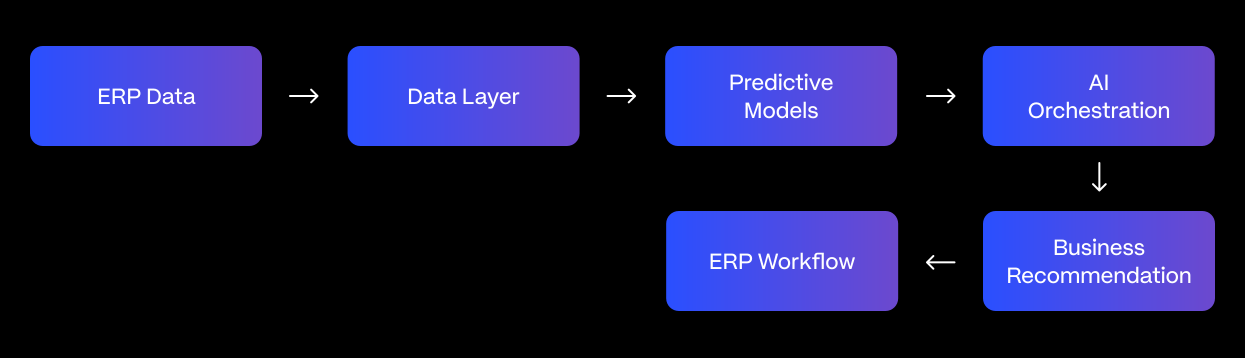
Technostacks consolidated ERP inputs historical demand, inventory levels, purchase orders, supplier performance, lead times, sales trends, warehouse and delivery data into a single analytical layer that feeds the AI models.
Predictive ML Models
Machine-learning models continuously analyze these patterns to forecast demand and predict when inventory will fall below safe thresholds, replacing static historical averages with forward-looking projections.
AI Orchestration & Recommendations
An AI orchestration layer interprets the model outputs and converts them into specific, explainable business recommendations for example, flagging a product at stock-out risk and recommending a replenishment quantity from a named supplier.
Human-in-the-Loop Approval
Every recommendation flows through a controlled workflow AI recommendation, human approval, purchase requisition, ERP so planners keep the final decision while the ERP remains the system of record.
How It Works
The AI-powered ERP automation layer runs as a continuous pipeline, from raw ERP data to a human-approved action written back into the ERP:
Key Use Cases
The same predictive layer powers several supply chain and inventory use cases:
Demand Forecasting
Predicts future demand from historical sales, seasonality and business variables.
Inventory Optimization
Identifies excess inventory, slow-moving stock, stock-out risks and reorder opportunities.
Supplier Risk
Flags suppliers with declining delivery performance, rising lead times or increasing rejection rates.
Supply Disruption Analysis
Combines supplier, inventory, order and logistics data to surface disruptions that could impact revenue.
Scenario Planning
Models the impact of changes such as a 15% demand increase on inventory, procurement and production.
Technologies Used
AI/ML Models
Predictive Analytics
Demand Forecasting Engine
AI Orchestration Layer
Recommendation Engine
Human-Approval Workflow
Data Pipeline
ERP Integration (ERPNext, SAP, Microsoft Dynamics, Zoho, custom)
The Shift: Reactive to Predictive
The core outcome is a change in operating model.
- A traditional ERP follows Record → Report → React: it answers “what happened?”, surfaces problems only after they appear in reports, and leaves planners to act on static historical analysis.
- The AI-enabled ERP follows Monitor → Predict → Recommend → Act: it answers “what’s likely next?” and “what should we do?”, surfaces risks to the right person early through continuous predictive analysis, and turns them into human-approved recommendations.
Impact
The AI-powered ERP automation layer is designed to deliver measurable gains across forecasting, inventory, and responsiveness:
Conclusion
Technostacks transformed the client’s ERP from a system that recorded and reported transactions into an intelligent, AI-powered supply chain layer that predicts risks and recommends action. By combining ERP data with machine-learning models, an AI orchestration layer and human-approved workflows, the solution moved planning from reactive reporting to proactive, forward-looking decision-making without disrupting the ERP as the system of record.
With predictive demand forecasting, inventory optimization and supplier-risk intelligence in place, the client now has a scalable foundation to anticipate disruptions, protect working capital and make faster supply-chain decisions as data volumes grow.
Ready to Turn Your ERP Data Into Predictive Supply Chain Decisions?
Whether you run on ERPNext, SAP, Microsoft Dynamics, Zoho, or a custom ERP, Technostacks can add an AI layer that forecasts demand, optimizes inventory, and flags supplier risk while keeping decisions with your team.
Our Solutions in Action
-
Software & Platforms • Cloud & DevOps • Digital Products • Product Engineering: A Land Parcel and Stakeholder Management Platform for a Land Services Software Company

A Land Parcel and Stakeholder Management Platform for a Land Services Software Company
The platform brings parcel mapping, stakeholder engagement, and project operations onto one system for a Calgary-based land, stakeholder, and project management software company, replacing s…

-
Software & Platforms • Cloud & DevOps • Digital Products • Internet of Things (IoT) • Product Engineering: A Map-First Geospatial Platform for Drone, Seedcane and Field Operations
A Map-First Geospatial Platform for Drone, Seedcane and Field Operations
Sense SaaS brings farm and site operations onto one map. Landowners order drone and lab services against mapped fields, growers manage certification and yield programmes, and field teams cap…

-
Real Estate • Cloud & DevOps • Data & AI • Digital Products • Product Engineering: Automated Utility Bill Data Extraction for Property Portfolios
Automated Utility Bill Data Extraction for Property Portfolios
BillSlayer reads electricity, water, refuse, and municipal rates bills on its own and turns them into live cost dashboards. Owners forward a bill by email, WhatsApp, or web upload, and the n…

-
Real Estate • Data & AI • Digital Products • Product Engineering: From Fragmented Systems to One Dashboard: A PropTech Platform for Modus10
From Fragmented Systems to One Dashboard: A PropTech Platform for Modus10
Modus10 (a South Africa-based property management firm) now runs leasing, utilities, access control, and tenant services from a single dashboard, replacing the paperwork and disconnected sys…

-
Industrial • Data & AI • ERP • Generative AI: From Stuck to Resolved: An AI Agent for ERP Exception Resolution
From Stuck to Resolved: An AI Agent for ERP Exception Resolution
Turning ERP exceptions into explanations and recommended fixes.

-
Real Estate • ERP: From Spreadsheets to a Single Source of Truth: Custom Real Estate CRM and HRMS Platform – Part 1
From Spreadsheets to a Single Source of Truth: Custom Real Estate CRM and HRMS Platform – Part 1
Imagine a broker checking unit availability in one spreadsheet, calculating brokerage in a second, hunting for the signed agreement in a shared drive, and messaging HR separately to log a re…

-
Industrial • Data & AI • ERP • Generative AI: From Emails to ERP Transactions: AI-Powered Order Processing for Unstructured Requests
From Emails to ERP Transactions: AI-Powered Order Processing for Unstructured Requests
A one-line email asking to ship 500 units becomes a validated ERP sales order, read, matched to the right customer and material, and entered without anyone retyping a thing.
-
Industrial • Data & AI • ERP • Generative AI: AI-Powered Procurement Automation for Manufacturing
AI-Powered Procurement Automation for Manufacturing
How AI Eliminated Manual Procurement Across Manufacturing Ops
-
Real Estate • ERP: One Platform, Every Stage: A Connected ERP for the Complete Property Development Lifecycle
One Platform, Every Stage: A Connected ERP for the Complete Property Development Lifecycle
One ERP for Land, Construction, Sales, Finance & Delivery


Lets Talk
Have a challenge?Let us know.