

Automated Utility Bill Data Extraction for Property Portfolios

Scroll Down

Jump to Section
3 Min Read time
Quick Snapshot
Technostacks built Sense SaaS, the platform behind BillSlayer, delivering automated utility bill data extraction and cost analytics for property portfolios. The multi-tenant SaaS reads electricity, water, refuse, and municipal rates bills submitted by email, WhatsApp, or web upload, pulls the data out automatically, including scanned and photographed bills via OCR, and maps it onto live dashboards and geospatial views. It replaced manual bill filing and spreadsheet tracking, where staff typed readings into Excel and often missed overcharges for months. Property managers now open one dashboard instead of a folder of PDFs, with cost and consumption visible per property, per meter, and per month.
Brief
The client managed utility accounts across many properties and meters, with bills arriving as PDFs and scanned images from multiple municipalities and providers, each with its own layout and table structure. Someone had to open every bill, type the account number, meter reading, usage, and charges into a spreadsheet, then file the PDF separately. There was no single view of spend, no comparison across properties, and no alert when a bill went missing or a charge spiked, and disputes were hard to win because the proof was scattered.
Bills now enter in three ways: a private email address per account, WhatsApp, or drag-and-drop upload. Every file is virus-scanned, parsed, mapped to a property and meter, and stored as a billing event, with dashboards, a map view, multichannel alerts, five export formats and self-service subscription billing on top.
Technostacks built Sense SaaS as a full product: a Vue 3 web app, a Django REST API, a Kafka-driven document processing pipeline, and a PostgreSQL/PostGIS data layer.
Challenges
Inconsistent Bill Formats
Every provider and municipality used its own layout and field names, so no single parser could handle them without a code release each time a template changed.
Hours of Manual Data Entry
Staff opened each PDF and retyped values into spreadsheets every month slow, and easy to get wrong.
Unreadable Scanned Bills
A large share of bills arrived as photographed or scanned images rather than text PDFs, so text extraction alone could not capture them.
Missing Bills Went Unnoticed
If a provider skipped a month or a bill was lost in an inbox, nobody knew until an arrears notice arrived.
No Portfolio-Level Visibility
Spend could not be compared across properties or time, so overcharges and consumption spikes were found late or not at all.
Solution We Provide
Technostacks built Sense SaaS as a configuration-driven platform that automates the full bill lifecycle without hard-coding a parser per provider.
Multi-Channel Bill Intake
Every account gets a private email address, a WhatsApp number, and a web uploader all three feed the same pipeline, so the user just forwards the bill and does nothing else.
Configuration-Driven Extraction Engine
An Invoice Type Registry holds each provider’s bill format, linked to seven text-extraction and OCR strategies. Adding a provider or handling a redesign is a configuration change, not a code release.
Two-Phase Field Recognition
The system first extracts the account number and billing date to identify the provider, then loads that provider’s field profile to pull the full billing data why one engine handles many unrelated bill layouts.
Billing Cycles & Auto-Forecasting
Each bill attaches to a property and meter as a billing event; when a cycle completes, the system creates the next expected cycle, so a missing bill becomes visible instead of a silent gap.
Maps, Dashboards & Reporting
Properties and meters are drawn on an OpenLayers map served by GeoServer and stored in PostGIS, with dashboards for cost and consumption trends and exports to five formats.
Multi-Tenant Accounts & Billing Ops
Team roles, multichannel alerts, and self-service subscription billing through Zoho Billing and Paystack let the client run commercial operations without a separate admin team.
How It Works
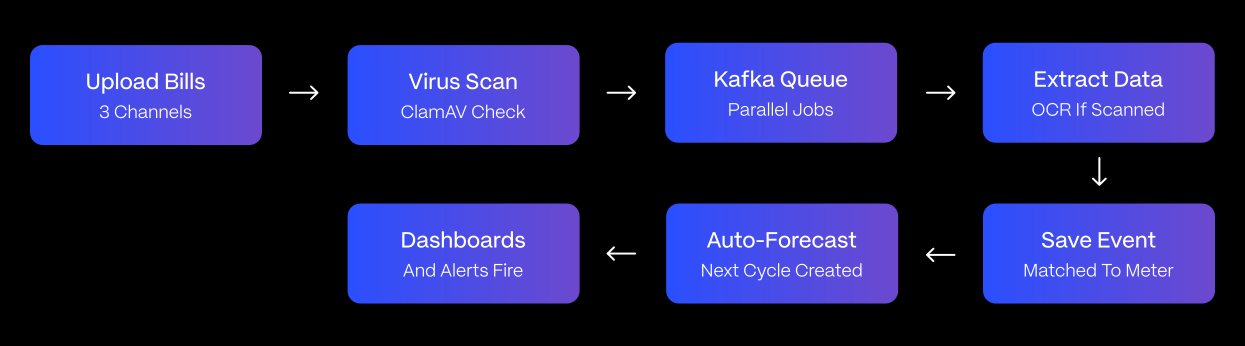
- Trigger: The user forwards the bill by email, WhatsApp, or upload — one at a time or in batches.
- Scan & queue: ClamAV scans every file; clean files publish to Kafka for parallel processing.
- Identify: Account number and billing date are extracted first to identify the provider.
- Extract: The provider’s field profile pulls the full data set; OCR runs for scanned bills.
- Save: The bill matches to its property and meter and is stored as a billing event.3
- Forecast: The next billing cycle is created automatically, so a missing bill becomes visible.
- Outcome: Dashboards and reports update, and alerts fire by email, WhatsApp, or SMS.
Technologies Used
Frontend:
Vue 3, TypeScript, Kendo UI, Tailwind CSS
Mapping:
OpenLayers, GeoServer, PostGIS
Backend:
Python, Django REST Framework, Celery, Apache Kafka
Extraction & OCR:
pdfplumber, Camelot, Tesseract OCR, OpenCV
Database:
PostgreSQL 16, PostGIS 3
Integrations:
SendGrid, Twilio, Zoho Billing, Paystack, SAML SSO
Security & DevOps:
ClamAV, JWT, TOTP MFA, Docker, GitLab CI/CD, Sentry
Impact
Sense SaaS replaced a manual, spreadsheet-based process with a system that surfaces problems automatically instead of hiding them:
Conclusion
Technostacks turned a manual, spreadsheet-based chore into an automated data product for Sense SaaS. Bills that used to be opened, read, and retyped one by one now arrive by email, WhatsApp, or upload and become structured, mapped data on their own, moving the client from filing documents to reading dashboards, and from finding an overcharge months later to seeing it in the current cycle.
The client is now set up to grow without adding headcount: new providers and bill formats are added as configuration, not code, and the platform already carries subscriptions, payments, team roles, and support ticketing a foundation ready to extend into new regions and document types like telecom, waste, or fuel invoices.
Automating Bill or Document Capture for Your Portfolio?
Whether it’s utility bills, invoices, or any recurring document type, Technostacks can build a configuration-driven extraction platform that turns paperwork into live dashboards without a code release for every new format.
Our Solutions in Action
-
Software & Platforms • Cloud & DevOps • Digital Products • Product Engineering: A Land Parcel and Stakeholder Management Platform for a Land Services Software Company

A Land Parcel and Stakeholder Management Platform for a Land Services Software Company
The platform brings parcel mapping, stakeholder engagement, and project operations onto one system for a Calgary-based land, stakeholder, and project management software company, replacing s…

-
Software & Platforms • Cloud & DevOps • Digital Products • Internet of Things (IoT) • Product Engineering: A Map-First Geospatial Platform for Drone, Seedcane and Field Operations
A Map-First Geospatial Platform for Drone, Seedcane and Field Operations
Sense SaaS brings farm and site operations onto one map. Landowners order drone and lab services against mapped fields, growers manage certification and yield programmes, and field teams cap…
-
Real Estate • Data & AI • Digital Products • Product Engineering: From Fragmented Systems to One Dashboard: A PropTech Platform for Modus10
From Fragmented Systems to One Dashboard: A PropTech Platform for Modus10
Modus10 (a South Africa-based property management firm) now runs leasing, utilities, access control, and tenant services from a single dashboard, replacing the paperwork and disconnected sys…

-
Industrial • Data & AI • ERP • Generative AI: From Stuck to Resolved: An AI Agent for ERP Exception Resolution
From Stuck to Resolved: An AI Agent for ERP Exception Resolution
Turning ERP exceptions into explanations and recommended fixes.

-
Real Estate • ERP: From Spreadsheets to a Single Source of Truth: Custom Real Estate CRM and HRMS Platform – Part 1
From Spreadsheets to a Single Source of Truth: Custom Real Estate CRM and HRMS Platform – Part 1
Imagine a broker checking unit availability in one spreadsheet, calculating brokerage in a second, hunting for the signed agreement in a shared drive, and messaging HR separately to log a re…

-
Industrial • Data & AI • ERP • Generative AI: AI-Powered ERP Automation for Predictive Supply Chain & Inventory
AI-Powered ERP Automation for Predictive Supply Chain & Inventory
From reactive ERP reports to predicted, human-approved reorders.

-
Industrial • Data & AI • ERP • Generative AI: From Emails to ERP Transactions: AI-Powered Order Processing for Unstructured Requests
From Emails to ERP Transactions: AI-Powered Order Processing for Unstructured Requests
A one-line email asking to ship 500 units becomes a validated ERP sales order, read, matched to the right customer and material, and entered without anyone retyping a thing.
-
Industrial • Data & AI • ERP • Generative AI: AI-Powered Procurement Automation for Manufacturing
AI-Powered Procurement Automation for Manufacturing
How AI Eliminated Manual Procurement Across Manufacturing Ops

-
Real Estate • ERP: One Platform, Every Stage: A Connected ERP for the Complete Property Development Lifecycle
One Platform, Every Stage: A Connected ERP for the Complete Property Development Lifecycle
One ERP for Land, Construction, Sales, Finance & Delivery


Lets Talk
Have a challenge?Let us know.