

From Spreadsheets to a Single Source of Truth: Custom Real Estate CRM and HRMS Platform – Part 1

Scroll Down

Jump to Section
3 Min Read time
Quick Snapshot
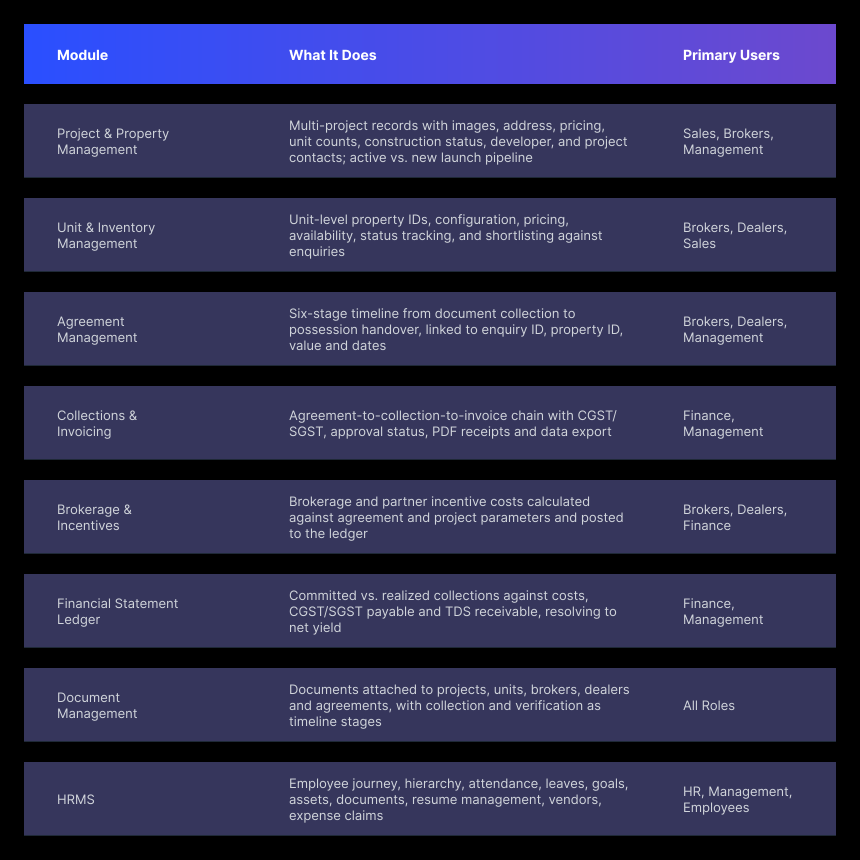
Technostacks built a custom real estate CRM and HRMS platform for a real estate brand in India, replacing fragmented spreadsheets, manual brokerage calculations, and scattered document folders with a single operations system. The platform centralizes developer project and property management, unit-level inventory, enquiry-to-possession agreement tracking across a six-stage timeline, collections, GST-compliant invoicing, a financial statement ledger, document management, and a full HRMS module in one role-based environment. Brokers and dealers work agreements in the same system that finance uses for collections, CGST and SGST calculation, and net-yield reporting, and HR uses for attendance, leaves, goals, assets, and expense claims. Technostacks designed the platform to scale across multiple projects, large unit inventories, and multiple user groups without pushing teams back into parallel tools.
Project Brief
The client operates across multiple real estate projects, each carrying a large number of units, and coordinates a network of brokers and dealers alongside internal sales, finance, and HR teams. Project details, unit availability, pricing, and customer requirements were held in spreadsheets and individual inboxes. Every agreement was tracked informally, brokerage was calculated by hand, collections and invoices were reconciled manually against GST liabilities, and agreements and approval documents were stored across drives and physical files. Management had no single view of which units were available, which agreements were progressing, what had actually been collected against what was billed, or how workforce activity connected to business activity.
Technostacks designed and developed a centralized real estate operations platform covering developer project and property management, unit inventory, agreement lifecycle tracking, collections and invoicing with CGST and SGST handling, a financial statement ledger, document management, and an integrated HRMS module.
Challenges
Fragmented Project and Inventory Records
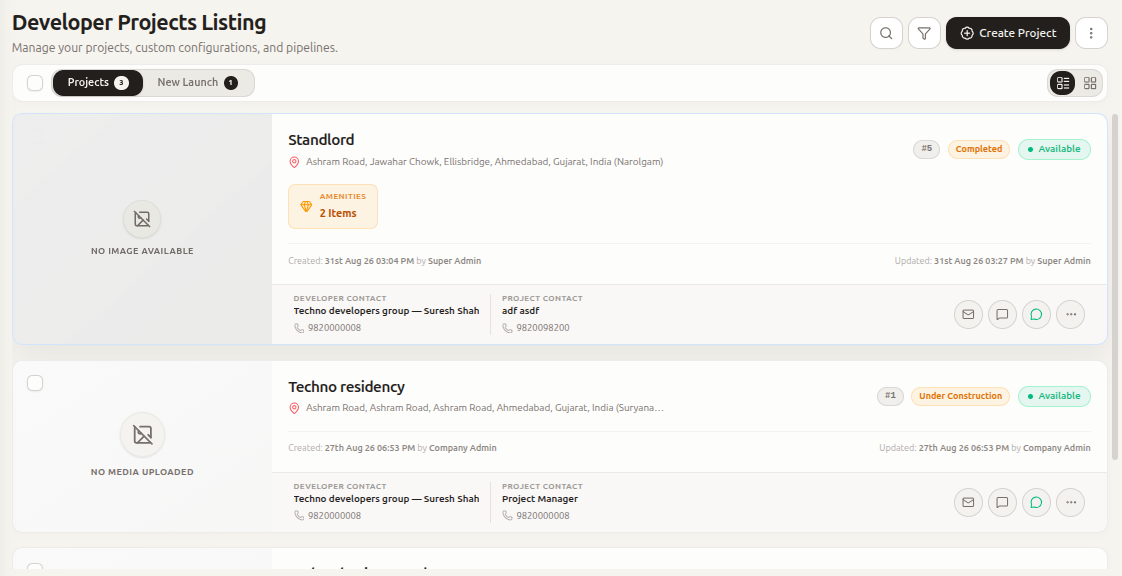
Project information, unit counts, pricing, images, construction status, and developer contacts were spread across spreadsheets and shared folders with no authoritative version. Teams could not reliably answer basic availability questions without calling someone.
Untracked Agreement Progress
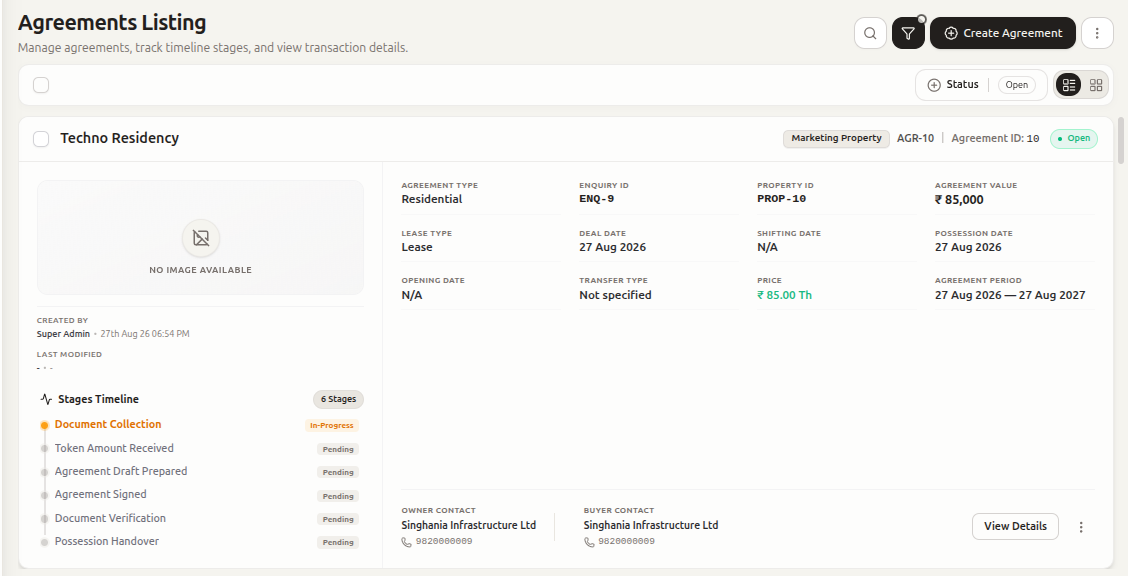
An agreement moved from enquiry to possession through calls and messages rather than a tracked status. Nobody could see whether documents had been collected, whether the token amount had landed, or where a transaction had stalled.
Manual Brokerage and Incentive Calculation
Brokerage and partner incentive costs were computed by hand against agreement and project parameters, making broker and dealer earnings slow to produce and difficult to audit or reconcile.
Disconnected Collections, Invoicing and GST
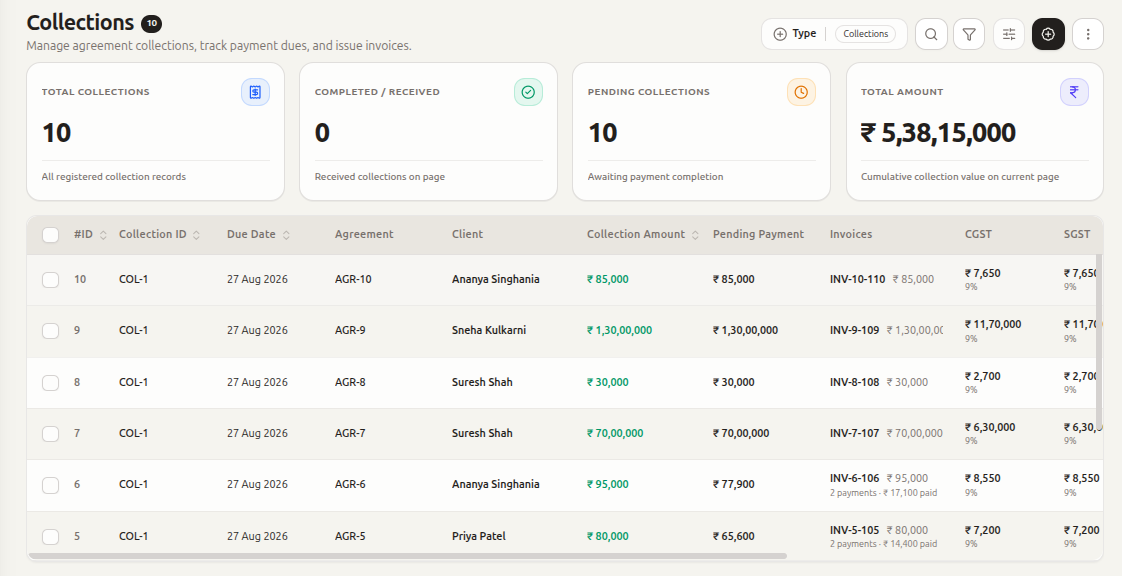
Billed commitments, actual payments received, and CGST and SGST liabilities were tracked in separate spreadsheets, so the gap between commitments and actual receipts was never visible in real time.
Scattered Transaction Documents
Agreements, project files, broker and dealer records, and deal paperwork were held in physical folders and unstructured drives. Retrieving the correct document during an active transaction consumed time and created a dependency on specific people.
Disconnected Workforce Operations
Attendance, leaves, goals, assets, reimbursements, and employee records were tracked outside business workflows, so management had to reconcile two unrelated views of the same organization to understand capacity and accountability.
Solution
We provided a centralized real estate CRM and HRMS platform built around how brokers, dealers, sales, finance, management, and HR teams actually work, rather than around a generic contact-and-lead CRM model.
Project and Property Management
A developer project layer to add and manage multiple projects, each with images, address, pricing, unit counts, status, and contacts. Projects are split into active inventory and new launches, filterable by city, area, and project.
Inventory and Unit Management
Unit-level inventory where every unit carries its own ID, configuration, pricing, and status. Brokers shortlist units against enquiries and update status, giving management live availability across projects.
Agreement and Deal Lifecycle Management
Agreement tracking from enquiry to possession across six stages: document collection, token, draft, signed, verified, and handover. Each links to enquiry and property IDs, value, dates, and owner/buyer contacts.
Collections, Invoicing and Brokerage
Each agreement links to a collection and each collection to an invoice, so amounts and bills reconcile automatically. Invoices calculate CGST/SGST, move through approval, and issue as PDF receipts; brokerage posts to the ledger.
Financial Statement Ledger and Micro-Budget Tracking
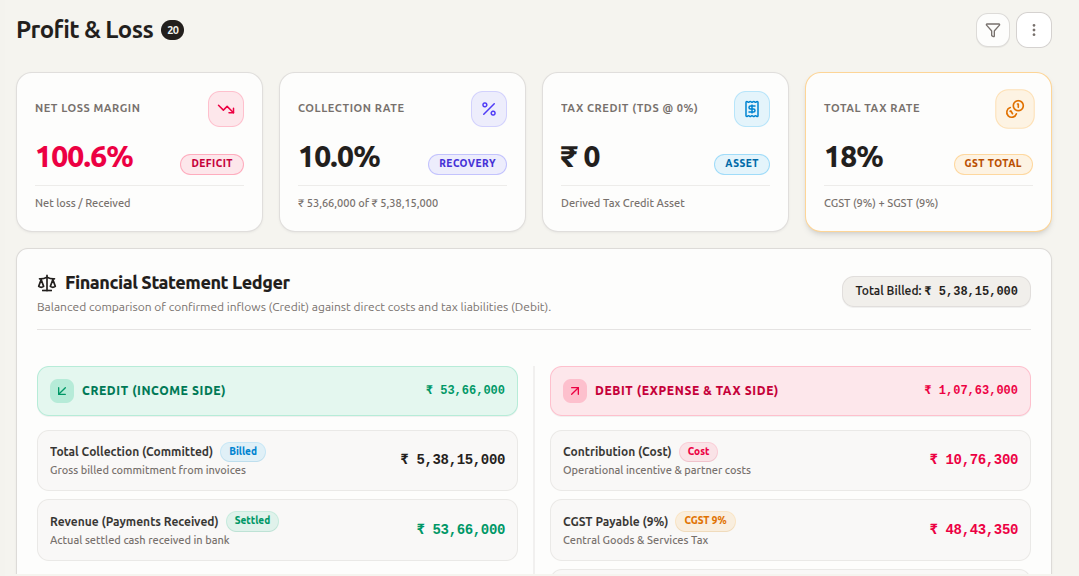
A ledger setting confirmed inflows against costs and tax on one screen, separating committed collection from revenue settled in the bank. Costs, CGST/SGST payable, and TDS receivable resolve to a cumulative outflow and net yield.
Integrated HRMS
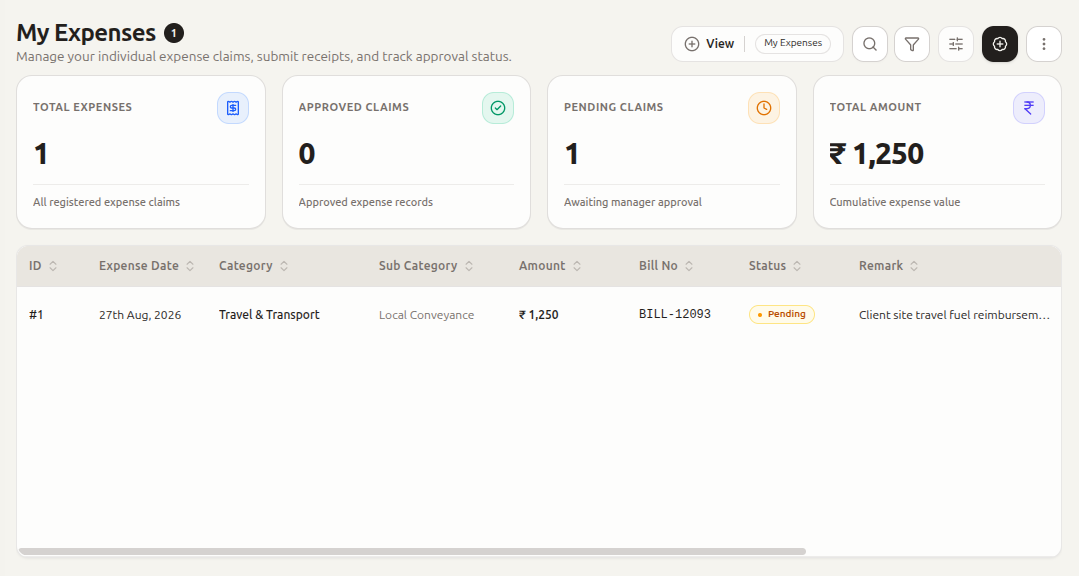
An HRMS built into the same platform, covering hierarchy, attendance, leaves, goals, assets, documents, and vendors. Expense claims run through tiered, bill-backed approvals from pending to paid.
Inventory and Unit Management
Unit-level inventory where every unit carries its own ID, configuration, pricing, and status. Brokers shortlist units against enquiries and update status, giving management live availability across projects.
Technologies Used
Frontend framework
Backend framework
Language
Database
Cloud/Hosting
Authentication & role management
PDF generation (invoices/receipts)
Export/reporting library
Any third-party APIs
Impact
Outcomes are described qualitatively. No quantified performance metrics have been shared for this implementation, and no figures have been estimated. Values visible in the product screenshots are seeded demo data and are not client results.
conclusion
Technostacks turned a set of disconnected spreadsheets, manual calculations, and scattered document folders into a single real estate operations platform. By connecting project and property management, unit inventory, a six-stage agreement lifecycle, collections and GST-compliant invoicing, brokerage calculation, a financial statement ledger, document management, and HRMS in one role-based system, the platform gave brokers, dealers, sales, finance, HR, and management a shared source of truth for both business and workforce operations. This is a broader remit than a conventional real estate CRM, which typically stops at leads and contacts; the same pattern Technostacks applies across real estate software development engagements.
Looking to Centralize Your Real Estate Operations?
Let’s build custom real estate CRM and HRMS platforms that bring the whole operation into one place.
Our Solutions in Action
-
Software & Platforms • Cloud & DevOps • Digital Products • Product Engineering: A Land Parcel and Stakeholder Management Platform for a Land Services Software Company

A Land Parcel and Stakeholder Management Platform for a Land Services Software Company
The platform brings parcel mapping, stakeholder engagement, and project operations onto one system for a Calgary-based land, stakeholder, and project management software company, replacing s…

-
Software & Platforms • Cloud & DevOps • Digital Products • Internet of Things (IoT) • Product Engineering: A Map-First Geospatial Platform for Drone, Seedcane and Field Operations
A Map-First Geospatial Platform for Drone, Seedcane and Field Operations
Sense SaaS brings farm and site operations onto one map. Landowners order drone and lab services against mapped fields, growers manage certification and yield programmes, and field teams cap…
-
Real Estate • Cloud & DevOps • Data & AI • Digital Products • Product Engineering: Automated Utility Bill Data Extraction for Property Portfolios
Automated Utility Bill Data Extraction for Property Portfolios
BillSlayer reads electricity, water, refuse, and municipal rates bills on its own and turns them into live cost dashboards. Owners forward a bill by email, WhatsApp, or web upload, and the n…

-
Real Estate • Data & AI • Digital Products • Product Engineering: From Fragmented Systems to One Dashboard: A PropTech Platform for Modus10
From Fragmented Systems to One Dashboard: A PropTech Platform for Modus10
Modus10 (a South Africa-based property management firm) now runs leasing, utilities, access control, and tenant services from a single dashboard, replacing the paperwork and disconnected sys…

-
Industrial • Data & AI • ERP • Generative AI: From Stuck to Resolved: An AI Agent for ERP Exception Resolution
From Stuck to Resolved: An AI Agent for ERP Exception Resolution
Turning ERP exceptions into explanations and recommended fixes.

-
Industrial • Data & AI • ERP • Generative AI: AI-Powered ERP Automation for Predictive Supply Chain & Inventory
AI-Powered ERP Automation for Predictive Supply Chain & Inventory
From reactive ERP reports to predicted, human-approved reorders.

-
Industrial • Data & AI • ERP • Generative AI: From Emails to ERP Transactions: AI-Powered Order Processing for Unstructured Requests
From Emails to ERP Transactions: AI-Powered Order Processing for Unstructured Requests
A one-line email asking to ship 500 units becomes a validated ERP sales order, read, matched to the right customer and material, and entered without anyone retyping a thing.
-
Industrial • Data & AI • ERP • Generative AI: AI-Powered Procurement Automation for Manufacturing
AI-Powered Procurement Automation for Manufacturing
How AI Eliminated Manual Procurement Across Manufacturing Ops
-
Real Estate • ERP: One Platform, Every Stage: A Connected ERP for the Complete Property Development Lifecycle
One Platform, Every Stage: A Connected ERP for the Complete Property Development Lifecycle
One ERP for Land, Construction, Sales, Finance & Delivery


Lets Talk
Have a challenge?Let us know.