

From Stuck to Resolved: An AI Agent for ERP Exception Resolution

Scroll Down

Jump to Section
3 Min Read time
Quick Snapshot
Technostacks built an AI agent for ERP exception resolution that continuously monitors ERP processes, detects the transactions that don’t move as expected, and investigates why. Instead of leaving employees to search across ERP screens, emails, documents, and other systems, the agent gathers the complete business context transactions, customer and vendor data, orders, invoices, inventory, payments, workflow history, and business rules to find the root cause and recommend the next action. High-impact financial and operational actions stay behind human approval, while low-risk fixes can be executed automatically, with everything logged for audit. The ERP remains the system of record; the AI becomes the system of investigation and decision support.
Brief
ERP systems process thousands of transactions a day, but the real operational effort comes from the ones that stall: invoices get blocked, purchase orders stay open, shipments slip, payments fail, and sales orders land on hold. The ERP can show what went wrong, yet employees still have to piece together why by searching across multiple systems.
Technostacks built an AI operations agent to remove that investigation effort. Rather than reporting “this transaction is stuck,” the agent explains why it is stuck, assembles the relevant context, and recommends what to do next, turning a raw exception into an explained, actionable decision that a person can approve.
Challenges
High Manual Investigation Effort
Understanding a single stuck transaction meant manually searching across ERP screens, emails, documents, and connected systems to reconstruct what had happened.
Exceptions Without Root Cause
The ERP could flag that something went wrong, but not why, leaving employees to diagnose the underlying cause themselves.
Hidden Downstream Impact
A procurement or payment exception often carried a downstream consequence a production or delivery risk that was not visible from the isolated ERP record.
Heavy ERP Support Workload
Routine “why is this stuck?” questions consumed support and finance time that could have gone to resolution rather than investigation.
Solution
Technostacks designed an AI operations agent that investigates and resolves ERP exceptions across finance, orders, procurement, and supply chain, built around the existing ERP rather than replacing it.
Continuous Monitoring & Exception Detection
The agent continuously watches ERP processes and business data, detecting exceptions blocked invoices, credit holds, delayed POs, failed payments as they arise instead of at month-end.
Full-Context Retrieval
For each exception, the agent pulls together transactions, customer and vendor data, orders, invoices, inventory, payments, workflow history, emails, documents and business rules to investigate the complete business context, not an isolated record.
AI Root-Cause Investigation
Using that context, the agent identifies the underlying cause; for example, an unreconciled payment behind a credit hold, or an emailed supplier date the ERP never captured.
Explained, Recommended Actions
The agent returns a plain-language explanation and a specific recommended next step, so the employee receives the answer and the fix rather than another screen to inspect.
Controlled Autonomy with Human Approval
Low-risk actions can be automated while high-impact financial or operational actions require approval and every investigation, recommendation and action is logged for audit and review.
How It Works
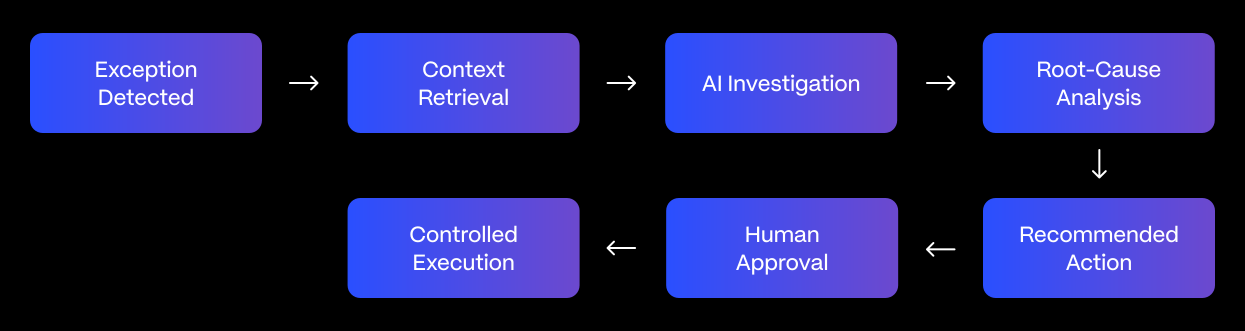
The agent runs as an investigation pipeline, from a detected exception to a human-approved, controlled resolution:
Example — Sales Order on Hold
The ERP shows Order #58291 on hold. The agent investigates: order value ₹18.5 lakh, inventory available, credit status on hold, outstanding receivables ₹58 lakh against a ₹50 lakh credit limit and finds a ₹12 lakh payment received but not yet reconciled.
It reports: the order is blocked because the customer’s outstanding balance exceeds its credit limit, and a recent ₹12 lakh payment remains unreconciled.
- Recommended action: reconcile the payment and re-evaluate the customer’s credit position.
Example — Delayed Purchase Order
The ERP shows PO-83921 awaiting delivery. The agent discovers the supplier changed the delivery date from September 3 to September 15 by email, but the ERP was never updated and that the component is required for Production Order #4912, scheduled for September 7.
It flags a production risk: Supplier X has delayed Component A by 12 days while the ERP still shows the original date.
- Recommended action: update the supplier confirmation and notify the production planner. The agent connects a procurement exception to its downstream production impact.
Use Cases
The same agent applies across the functions where ERP exceptions create the most manual work:
- Accounts Payable: invoice mismatches, duplicate invoices, missing POs or GRNs, tax inconsistencies, blocked invoices and payment failures.
- Order Management: credit holds, delivery delays, billing failures, inventory issues and customer-data problems.
- Procurement: delayed POs, pending supplier confirmations, price mismatches and approval bottlenecks.
- Supply Chain: material shortages, supplier delays, inventory risks and production or delivery risks.
- Finance: reconciliation gaps, payment failures, unusual transactions, outstanding balances and duplicate payments.
- ERP Support: answering questions like “why can’t this PO be approved?” or “why hasn’t this invoice been paid?” by investigating the workflow and explaining the issue.
Technologies Used
AI Agents (Agentic AI)
Large Language Model (LLM)
Context Retrieval (RAG across ERP, emails & documents)
Root-Cause Analysis Engine
Process Monitoring & Exception Detection
Business-Rule Engine
Human-in-the-Loop Approval Workflow
Audit Logging
ERP Integration (SAP, Oracle, ERPNext, Microsoft Dynamics, Zoho, custom)
Controlled Autonomy
The agent operates along a governed ladder: Observe, Explain, Recommend, Prepare, Execute. Low-risk actions can be automated, while high-impact financial or operational actions require human approval, and every action is logged for audit and review. This keeps resolution fast without handing business-critical decisions to the AI.
The Shift: Detection to Resolution
A traditional ERP follows a reactive loop: something goes wrong, it is reported, an employee investigates, finds the cause and decides what to do. The AI-enabled ERP follows Detect → Understand → Recommend → Resolve: the agent detects the exception, gathers context, identifies the cause, recommends an action, a human approves, and the ERP executes. The ERP records the business; the AI helps keep the business moving.
Impact
The AI agent is designed to reduce the time spent understanding and resolving exceptions, not just the number of alerts:
Conclusion
Technostacks turned ERP exception handling from a manual, multi-system investigation into a governed AI workflow — one that detects what is stuck, explains why, and recommends the fix while keeping high-impact decisions with people. Built around the existing ERP with controlled autonomy and a full audit trail, it gives operations, finance, and procurement teams a practical foundation for extending agentic AI across every process where exceptions slow the business down.
Ready to Put an AI Agent to Work on Your ERP Exceptions?
ERP exceptions in payables, order management, procurement, or finance don’t need manual investigation — they need an AI agent that finds the cause, recommends the fix, and keeps your team in control of every high-stakes decision.
Our Solutions in Action
-
Software & Platforms • Cloud & DevOps • Digital Products • Product Engineering: A Land Parcel and Stakeholder Management Platform for a Land Services Software Company

A Land Parcel and Stakeholder Management Platform for a Land Services Software Company
The platform brings parcel mapping, stakeholder engagement, and project operations onto one system for a Calgary-based land, stakeholder, and project management software company, replacing s…

-
Software & Platforms • Cloud & DevOps • Digital Products • Internet of Things (IoT) • Product Engineering: A Map-First Geospatial Platform for Drone, Seedcane and Field Operations
A Map-First Geospatial Platform for Drone, Seedcane and Field Operations
Sense SaaS brings farm and site operations onto one map. Landowners order drone and lab services against mapped fields, growers manage certification and yield programmes, and field teams cap…

-
Real Estate • Cloud & DevOps • Data & AI • Digital Products • Product Engineering: Automated Utility Bill Data Extraction for Property Portfolios
Automated Utility Bill Data Extraction for Property Portfolios
BillSlayer reads electricity, water, refuse, and municipal rates bills on its own and turns them into live cost dashboards. Owners forward a bill by email, WhatsApp, or web upload, and the n…

-
Real Estate • Data & AI • Digital Products • Product Engineering: From Fragmented Systems to One Dashboard: A PropTech Platform for Modus10
From Fragmented Systems to One Dashboard: A PropTech Platform for Modus10
Modus10 (a South Africa-based property management firm) now runs leasing, utilities, access control, and tenant services from a single dashboard, replacing the paperwork and disconnected sys…

-
Real Estate • ERP: From Spreadsheets to a Single Source of Truth: Custom Real Estate CRM and HRMS Platform – Part 1
From Spreadsheets to a Single Source of Truth: Custom Real Estate CRM and HRMS Platform – Part 1
Imagine a broker checking unit availability in one spreadsheet, calculating brokerage in a second, hunting for the signed agreement in a shared drive, and messaging HR separately to log a re…

-
Industrial • Data & AI • ERP • Generative AI: AI-Powered ERP Automation for Predictive Supply Chain & Inventory
AI-Powered ERP Automation for Predictive Supply Chain & Inventory
From reactive ERP reports to predicted, human-approved reorders.

-
Industrial • Data & AI • ERP • Generative AI: From Emails to ERP Transactions: AI-Powered Order Processing for Unstructured Requests
From Emails to ERP Transactions: AI-Powered Order Processing for Unstructured Requests
A one-line email asking to ship 500 units becomes a validated ERP sales order, read, matched to the right customer and material, and entered without anyone retyping a thing.

-
Industrial • Data & AI • ERP • Generative AI: AI-Powered Procurement Automation for Manufacturing
AI-Powered Procurement Automation for Manufacturing
How AI Eliminated Manual Procurement Across Manufacturing Ops

-
Real Estate • ERP: One Platform, Every Stage: A Connected ERP for the Complete Property Development Lifecycle
One Platform, Every Stage: A Connected ERP for the Complete Property Development Lifecycle
One ERP for Land, Construction, Sales, Finance & Delivery


Lets Talk
Have a challenge?Let us know.