

Why AWS Consulting Is About Business Outcomes, and How Agentic SaaS Is Proving It
AWS consulting has traditionally been judged by technical milestones – servers migrated, uptime, services adopted, but roughly half of cloud migrations still fail to deliver the business value that was promised, because success was never defined as a business number in the first place. Agentic SaaS is exposing that same gap faster.
Most business owners hire an AWS consulting partner to get something migrated, modernized, or scaled. But the question that actually matters isn’t “did the project finish on time”; it’s “did any business number move because of it?” Revenue, cost per transaction, time to close, support cost per ticket. If none of those moved, the migration was a technical success and a business non-event.
That gap between technical delivery and business outcome has quietly defined cloud consulting for years. And right now, agentic SaaS, AI agents built directly into software platforms to complete real tasks, not just answer questions, is exposing that gap faster and more clearly than almost anything before it.
The Problem With “Technical Success” Metrics
Cloud migration has a well-documented outcome problem. Gartner research indicates that only around half of cloud migrations deliver the business value that was originally promised, even when the technical migration itself goes fine. Roughly 80% of cloud migration projects exceed their original budget or timeline, and 82% of cloud decision-makers say managing ongoing cloud spend, not the migration itself, is their biggest headache.
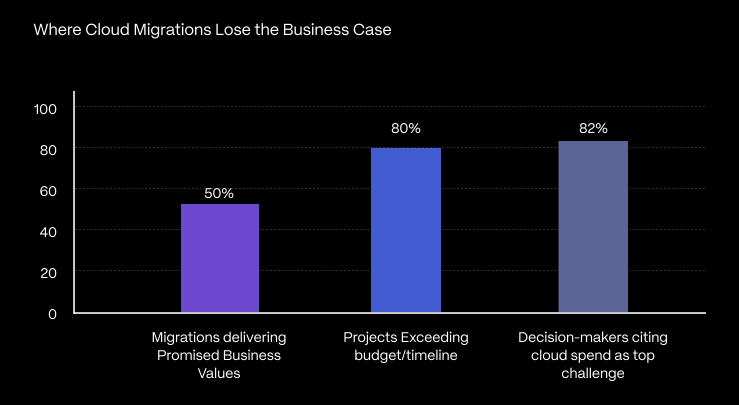
Source: Gartner, FinOps Foundation 2026 Survey
None of that is a technology failure. It’s a scoping failure: projects are measured by “servers moved” rather than “dollars saved” or “revenue enabled.”
| What Gets Measured | What Should Get Measured |
|---|---|
| Servers/workloads migrated | Cost per transaction or per customer |
| Uptime % | Revenue or conversions enabled |
| Migration completed on schedule | Time-to-market for new features |
| AWS services adopted | Support cost per resolved ticket |
What Outcome-First AWS Consulting Actually Looks Like
Outcome-based AWS consulting flips the scope of work. Instead of a statement of work built around infrastructure milestones, it’s built around a business KPI the consulting partner is accountable for, alongside the technical execution (architecture on the AWS Well-Architected Framework, cost governance, security posture). This is the model behind Technostacks’ AWS cloud consulting and managed services practice, with cost visibility and business-goal alignment built into the engagement, not billed later as a separate cleanup project. Cloud FinOps practices matter here too: Gartner estimates that without disciplined cloud financial governance, organizations could overspend by up to 25% annually by 2027.
This isn’t a small distinction for a business owner evaluating proposals. A partner scoped around “migrate X to AWS” and a partner scoped around “reduce infrastructure cost per order by 20%” will make different architecture decisions from day one, the same principle behind Technostacks’ broader Cloud & DevOps services.
Enter Agentic SaaS: The Outcome Pressure Test
Agentic SaaS platforms, software where autonomous AI agents actually complete a task (qualify a lead, reconcile an invoice, resolve a support ticket, schedule a shipment) rather than just chat about it, can’t hide behind “technically successful.” An agent’s output is binary: the invoice was reconciled, or it wasn’t. That makes agentic AI the clearest real-world proof of whether outcome-first thinking actually works, because there’s nowhere left to hide a project that was scoped around activity instead of results. Technostacks’ own multi-agentic enterprise solution build is one example of this outcome-first approach in practice, alongside our broader Generative AI and Data & AI work.
And the data shows exactly that split playing out right now:
Without a defined business outcome:
- Only about 23% of organizations report significant ROI from their AI agent initiatives
- Only about 23% of organizations report significant ROI from their AI agent initiatives
- 79% of enterprises have adopted AI agents in some form, but only around 11–23% have gotten them into real production at scale
- Gartner expects more than 40% of agentic AI projects to be cancelled by 2027, and cites the same root cause every time: unclear business value, not broken technology.
With a defined business outcome from day one:
- 96% of organizations with active, outcome-scoped agentic AI deployments report meeting or exceeding ROI expectations
- Top-performing agentic deployments report a median ROI of 171%, with payback in under nine months
- Deployments built around one measurable KPI, not a general-purpose assistant, are the ones that make it past the pilot stage
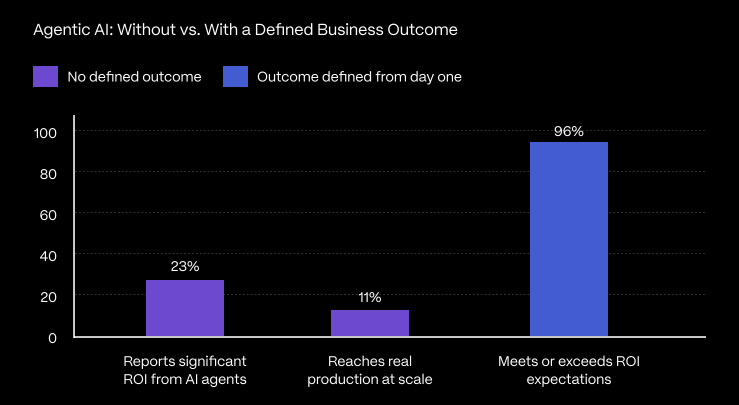
Source: Gartner; independent agentic AI industry trackers, 2026
That’s the same pattern as cloud migration, just compressed into months instead of years: projects without a defined outcome stall, get cancelled, or quietly disappoint. Projects built around one clear number tend to hit it. For governance considerations as these deployments scale, see our related read on the EU AI Act and what it requires for agentic AI systems.
What This Means for Business Owners Choosing a Partner
When evaluating an AWS consulting partner, or a proposal to bring agentic AI into your operations, the technical checklist (AWS certifications, migration methodology, security architecture) still matters. But it isn’t the differentiator anymore. The differentiator is whether the partner can answer one question clearly: what business number are you accountable for, and how will we measure it in 90 days?
If a proposed AWS engagement or agentic SaaS rollout can’t point to a specific KPI, cost per transaction, resolution time, revenue per user, deals closed- it’s being scoped the same way that put half of all cloud migrations in the “technically done, business unchanged” category. The agentic AI data over the past year makes that pattern harder to miss, not easier.
The Takeaway
AWS consulting was never really about the cloud. It was always about what the cloud lets a business do faster, cheaper, or better, and agentic SaaS has simply made that truth impossible to avoid, because an AI agent either delivers the outcome it was built for, or it doesn’t. The businesses getting real returns from both cloud modernization and AI agents share one habit: they define the business outcome before they define the architecture.
If you’re evaluating an AWS partner or scoping an agentic AI initiative, Technostacks can help define the KPI first; get in touch to talk through your goals.